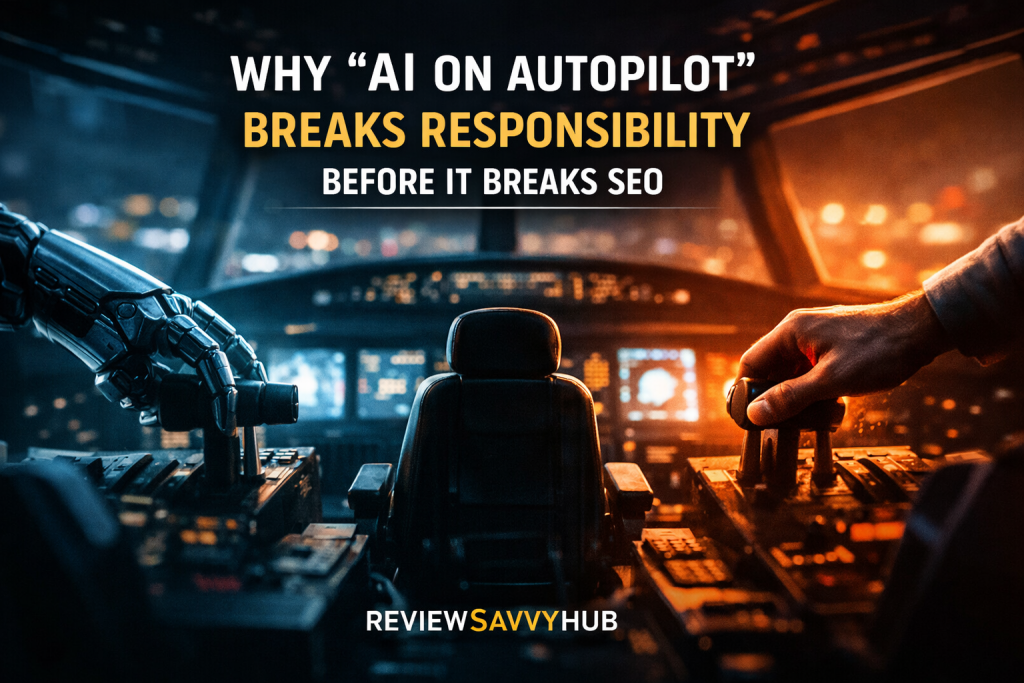
AI on Autopilot Responsibility is not an SEO problem at first — it is a judgment problem that quietly erodes accountability before rankings ever decline.
AI on autopilot promises efficiency — but it quietly erodes responsibility long before it affects SEO.
Automation has become one of the most seductive ideas in modern digital strategy. “Set it once.” “Let the system run.” “Scale without friction.” In SEO, content, and decision-making systems, this language feels efficient, even intelligent. Yet beneath the surface lies a deeper problem — one that damages judgement and trust before it ever shows up in rankings.
AI on autopilot does not fail because machines are incapable.
It fails because humans gradually step back.
The Seduction of Scale
Automation sells certainty. Calendars fill themselves. Dashboards light up. Content ships on schedule. For managers under pressure, “autopilot” feels like relief — a mirage of control without cognitive load.
This seduction works because it reframes responsibility as inefficiency. Human judgement is portrayed as slow. Oversight becomes optional. Intentional decision-making is quietly replaced by process.
The language shifts:
- Decisions become recommendations
- Ownership becomes workflow
- Accountability becomes the algorithm
This is how responsibility doesn’t disappear suddenly — it dissolves. What follows is algorithmic abdication: humans remain present in name, but absent in judgement.
The Autopilot Paradox
Here is the paradox most automation marketing avoids:
The more automated a system becomes, the more oversight it requires — not less.
In aviation, autopilot exists to reduce workload, not to remove responsibility. A pilot never relinquishes authority. Oversight remains constant. Automation supports judgement; it does not replace it.
In AI-driven SEO and content systems, the framing is different. Autopilot is sold as substitution rather than assistance. Content is generated, published, and amplified without editorial review. Links are built without contextual evaluation. Pages are created without validating user intent.
The system performs exactly as configured — efficiently, repeatedly, and without conscience.
Automation didn’t fail.
Stewardship did.
The Invisible Decay
SEO rarely collapses overnight. Trust erodes first.
Before rankings decline, something less visible begins to atrophy:
- Brand authority weakens
- Topical ownership dilutes
- Voice becomes generic
- Intent fragments
Users sense this before algorithms do. Engagement softens. Credibility fades. Content feels hollow — technically correct, strategically empty.
This is the hidden cost of excessive cognitive offloading. When judgement is outsourced entirely, brands lose their bedrock. By the time traffic graphs turn red, responsibility has already been absent for months.
SEO failure is not the cause.
It is the symptom.
AI vs. Human Judgement: The Responsibility Divide
The future of responsible SEO is not anti-AI. It is human-in-the-loop by design.
AI excels at acceleration, synthesis, and pattern recognition. Humans remain essential for:
- Context
- Ethics
- Strategic intent
- Brand custodianship
This is where E-E-A-T (Experience, Expertise, Authoritativeness, Trustworthiness) becomes more than a guideline. It becomes a digital responsibility framework.
When responsibility is retained:
- AI drafts are reviewed, not rubber-stamped
- Automation assists decisions, not replaces them
- Systems remain accountable to human judgement
This balance is becoming the defining advantage for brands that intend to last.
The New Standard: Intentionality as Strategy
The strongest brands will not be the fastest publishers or the loudest automators. They will be the most intentional.
Intentionality means:
- Knowing when not to automate
- Slowing down where judgement matters
- Treating AI as infrastructure, not authority
The illusion of autopilot promises freedom. In reality, it produces fragility. Scale without stewardship erodes trust. Efficiency without intent dilutes authority.
Responsible SEO is not about resisting technology. It is about refusing to surrender sovereignty.
Unequivocal Verdict
AI on autopilot does not break SEO first.
It breaks responsibility first.
When judgement is abdicated, failure becomes inevitable — not because algorithms are hostile, but because trust cannot be automated.
Technology redistributes responsibility. It does not remove it.
The brands that endure will not be those who automate the most, but those who remain accountable when automation makes it easiest to disappear.
ReviewSavvyHub Insight
This article is part of the AI Reality & Judgement Series, examining not what AI can do — but what humans are quietly choosing not to do anymore.
Editorial Note
This article reflects ReviewSavvyHub’s independent analysis of automation, responsibility, and long-term brand impact. It is not written to promote or oppose any specific AI tool, platform, or service. The focus is on decision-making frameworks and human accountability in automated systems.