Editorial Hook — What You’ll Get From This Article
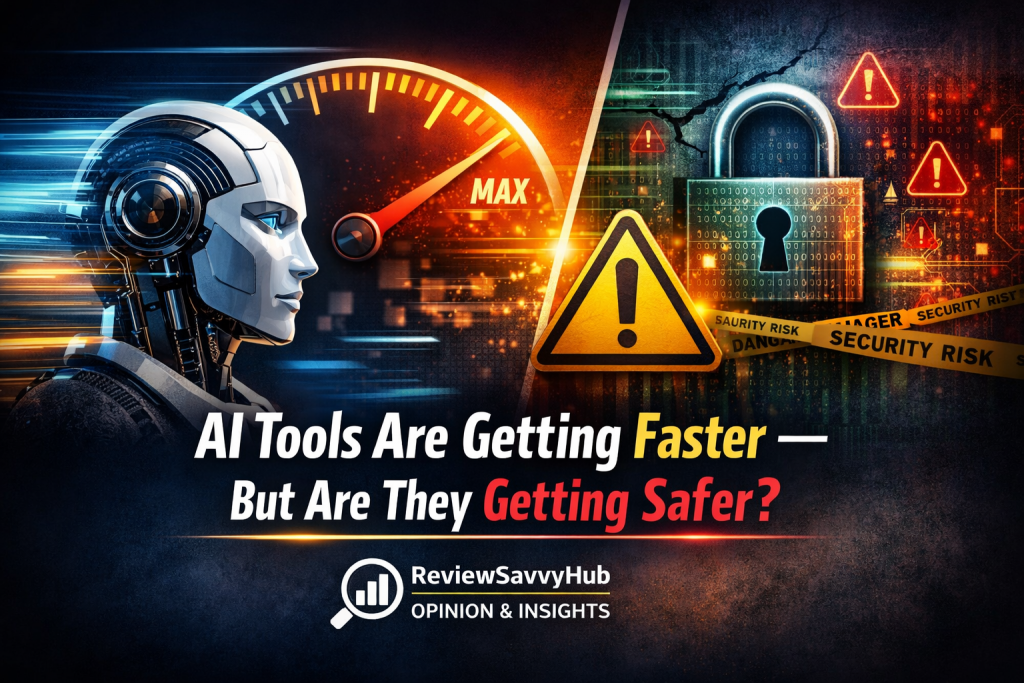
AI tools safety has become a critical concern as AI tools continue to improve at extraordinary speed.
Every few months, major platforms promise faster responses, deeper reasoning, and more “human-like” intelligence.
But this article asks a different question: as AI gets faster, is it actually becoming safer?
You’ll learn where modern AI genuinely helps, where safety is quietly falling behind, who is responsible for the risks, and why speed alone may be creating long-term trust problems for users, businesses, and society.
Context: The Race for Faster, Smarter AI
Over the past two years, artificial intelligence has entered a global speed race. Models such as ChatGPT, Gemini, Copilot, and Claude are updated at a rapid pace, with each release highlighting improvements in reasoning, multimodality, and productivity.
From a technical standpoint, this progress is impressive. AI can summarise long documents in seconds, generate usable code, analyse images, and assist with decision-making across business, education, and healthcare. Speed has become a competitive advantage — faster models attract users, investors, and enterprise adoption.
However, safety rarely headlines these announcements. It is often mentioned briefly, buried beneath performance claims. This growing imbalance between speed and responsibility is becoming harder to ignore.
The Reality Gap: Speed vs Reliability
Faster AI does not automatically mean more reliable AI.
In real-world use, many people encounter confident but incorrect answers, over-simplified explanations for complex problems, fabricated sources presented as facts, and inconsistent reasoning across similar prompts. These issues are not always obvious because speed creates an illusion of competence.
When responses arrive instantly and with confidence, users are less likely to question accuracy. The danger is subtle: errors feel authoritative because they are delivered quickly and without hesitation. This is not just a technical failure — it is a human trust problem.
Safety Isn’t Just About Errors
When people hear the phrase “AI safety,” they often think only about mistakes or wrong answers. In reality, AI tools safety covers a much broader range of risks.
These include bias amplification through training data, automation overreach in hiring, finance, and moderation, loss of human oversight in decision-making chains, dependency risks where users stop verifying information, and opaque accountability when AI outputs cause harm.
Most current AI tools still rely heavily on the user to detect these issues. At scale, that expectation is unrealistic and places responsibility on the least equipped party.
Who Is Responsible When AI Gets It Wrong?
This is where the conversation becomes uncomfortable.
AI companies position their products as “assistants,” not decision-makers. Yet their marketing increasingly promotes automation, efficiency, and replacement of manual work. When something goes wrong, responsibility quietly shifts to the user.
Businesses assume employees will “use AI responsibly.”
Individuals assume the system “knows what it’s doing.”
Regulators struggle to keep pace with rapid innovation.
The result is a responsibility gap. Everyone uses AI, but no one fully owns the consequences. From a long-term perspective, AI tools safety is as much a governance problem as it is a technological one.
Regulation Is Slower Than the Technology
Governments are attempting to respond. Initiatives such as the EU AI Act, UK AI principles, and similar frameworks aim to classify AI risks and introduce guardrails.
But legislation moves slowly by design. AI development does not.
By the time policies are debated, written, and enforced, the technology has already evolved. This creates a structural mismatch: fast innovation versus slow governance. Until this gap narrows, safety measures remain reactive rather than preventative.
Real-World Impact: Where the Risks Show Up
These concerns are no longer theoretical.
Students increasingly rely on AI answers without understanding context or limitations. Small businesses automate customer communication without adequate review. Recruiters use AI screening tools that may embed hidden bias. Content creators face growing trust issues as synthetic material floods digital platforms.
None of this means AI is harmful by default. However, unchecked speed significantly increases the cost of mistakes and magnifies their reach.
SWOT Analysis — AI Speed vs Safety
Strengths
AI delivers unmatched speed, scale, and accessibility for knowledge and productivity.
Weaknesses
Reliability, transparency, and explainability lag behind performance improvements.
Opportunities
Human-in-the-loop systems, auditability, and safety-first design could restore trust.
Threats
Over-automation, legal uncertainty, and public backlash if failures continue unchecked.
PESTLE Snapshot
Political: Governments struggle to regulate rapidly evolving AI systems.
Economic: Faster AI boosts productivity but increases systemic risk.
Social: Trust erosion as users encounter confident misinformation.
Technological: Innovation prioritises capability over control.
Legal: Accountability remains unclear in AI-assisted decisions.
Environmental: Rising compute demands raise sustainability concerns.
Accuracy & Limitations
This article does not claim that AI is unsafe by default, nor that speed is inherently harmful. Many platforms already include safety layers and guardrails. However, these protections vary widely and are often opaque to users.
The core limitation remains human behaviour. People tend to trust fast, confident systems more than they should.
Audience Reality — Who Should Care
This analysis is especially relevant for businesses integrating AI into workflows, educators and students relying on AI tools, content creators and digital professionals, and policymakers shaping future regulation.
Those expecting AI to replace human judgement entirely may find this perspective uncomfortable — but necessary.
Final Verdict — Progress Needs Restraint
AI tools are undeniably getting faster, but safety is not advancing at the same pace.
Speed without accountability creates fragile systems. Real progress will not come from faster answers alone, but from clear responsibility, transparent limitations, and deliberate human oversight.
Until then, the smartest use of AI remains cautious, critical, and informed.
ReviewSavvyHub Verdict:
AI progress is real — but safety must stop being optional.
Transparency Note
This article is editorial analysis, not sponsored content. It reflects observed trends across major AI platforms and public policy discussions, without affiliation to any AI vendor.