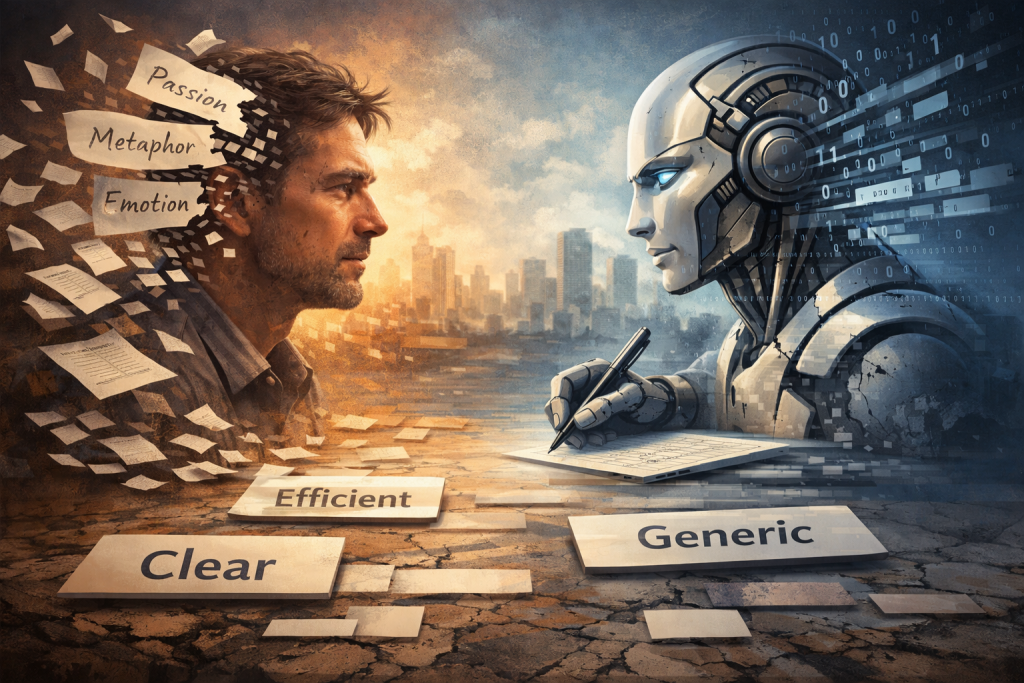
Semantic erosion of language does not arrive with alarms.
It does not announce itself with broken grammar or obvious mistakes.
It arrives quietly.
Language has always evolved. It absorbs culture, technology, and social change. But something fundamentally different is happening now. As AI-generated text becomes the default for emails, articles, marketing copy, education, and even personal communication, language is beginning to lose depth — not through censorship or restriction, but through repetition and optimisation.
There are no visible failures.
No grammatical collapse.
No clear moment where things “go wrong.”
Instead, meaning is gently smoothed out. Words remain correct, sentences remain polished, but emotion, originality, and nuance slowly fade.
This is the real nature of semantic erosion of language in the age of AI.
The AI Facade
AI systems are designed to be helpful, safe, and broadly acceptable. To achieve this, they rely on patterns — phrases and structures that perform well across millions of situations.
The result is language that appears polite, professional, and grammatically clean.
But beneath that surface, it is also emotionally neutral, metaphor-poor, and structurally repetitive.
This creates a powerful illusion. Everything sounds right — yet nothing feels alive.
AI does not damage language through error.
It damages it through averaging.
And when humans increasingly copy, reuse, and depend on this averaged expression, semantic erosion accelerates — quietly, efficiently, and without resistance.
When “Clarity” Replaces Meaning
One of the most celebrated qualities of AI writing is clarity.
Short sentences.
Direct phrasing.
Minimal ambiguity.
But ambiguity is not a weakness of human language. It is one of its strengths. Ambiguity allows emotional nuance, cultural context, irony, metaphor, and layered meaning to coexist.
When AI-styled language dominates communication, something subtle shifts:
Complex ideas are simplified.
Strong emotions are softened.
Context is stripped away.
Language becomes efficient — but thin.
Clear — but forgettable.
In the pursuit of clarity, meaning becomes negotiable.
The Copy-Paste Effect
The most damaging aspect of semantic erosion of language is not AI output itself.
It is human imitation.
As machine-generated tone becomes normalised, people begin to internalise it as the standard.
They start to write emails like machines.
They structure arguments like machines.
They remove personality to sound “professional.”
Gradually, originality is reclassified as risk.
This creates a self-reinforcing loop:
AI imitates humans → humans imitate AI → language flattens further
This is not a creativity crisis.
It is a linguistic conformity problem.
ReviewSavvyHub Analysis: Language Under Algorithmic Influence
Professional tone
What we are told: AI improves communication
What actually happens: Language loses emotional texture
Clarity
What we are told: Simpler is better
What actually happens: Depth and nuance disappear
Consistency
What we are told: Standardisation helps scale
What actually happens: Original voice becomes risky
Efficiency
What we are told: Faster writing saves time
What actually happens: Meaning is sacrificed for speed
The Human Bridge
Human language was never meant to be optimised.
It was meant to persuade, comfort, provoke, inspire — and sometimes even confuse.
AI excels at structure.
It does not excel at experience.
A machine can describe sadness.
It cannot carry it.
A model can generate metaphors.
It does not live inside them.
When humans outsource expression too heavily, they do not lose vocabulary. They lose emotional precision — and emotional precision is what separates information from understanding.
The Strategic Verdict
Semantic erosion of language does not happen overnight.
It happens one safe sentence at a time.
The future will not be divided between human and machine writing. It will be divided between those who preserve depth — and those who accept linguistic convenience.
AI should assist language — not define it.
Used carefully, it can clarify thought.
Used carelessly, it can flatten culture.
ReviewSavvyHub Judgement
Semantic erosion of language is not about incorrect words.
It is about interchangeable ones.
AI is not killing language, but unchecked reliance is draining it of texture, emotion, and individuality. Preserving meaning requires friction, personality, and conscious human intent.
Without them, language survives —
but expression does not.
This erosion of meaning becomes even more visible when human behaviour itself starts adapting to machine judgement. For a deeper examination of this shift, read our analysis on The Observer Effect in AI-Driven Workflows.