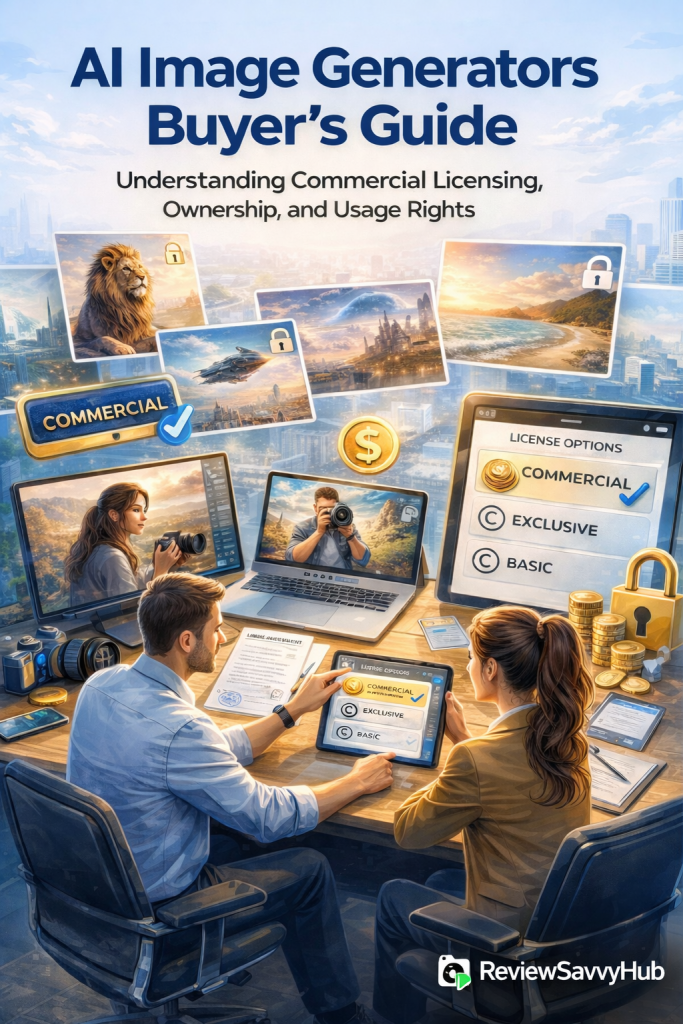
Decision Context — What This Guide Helps You Decide
This AI image generators buyers guide helps readers understand whether images created with AI tools can be used safely for commercial, professional, and business purposes.
AI image generators are now widely used for marketing visuals, website graphics, product mockups, social media content, and creative exploration. While output quality has improved rapidly, legal clarity has not kept pace. Many users assume that AI-generated images are automatically safe to use, an assumption that can introduce legal, reputational, and financial risk.
This guide exists to help buyers understand how licensing, ownership, and usage rights differ across categories of AI image generation platforms. It avoids ranking tools or recommending specific products. Instead, it focuses on decision clarity, limitations, and long-term suitability.
This AI image generators buyers guide is written for professionals who need clarity around licensing, ownership, and commercial usage before relying on AI-generated visuals. Rather than showcasing tools or outputs, it examines the decision risks and legal considerations that matter when AI images are used in real-world business environments.
Buyer Reality Check — Why Licensing Confusion Is the Real Risk
Most problems with AI image generators do not arise from poor image quality. They arise from misunderstanding usage rights.
Many platforms use layered or conditional licensing terms that change based on subscription level, geographic region, or intended use. Some allow broad commercial usage but restrict trademark registration. Others permit marketing use but prohibit resale or redistribution. In some cases, training data sources remain opaque, raising uncertainty around originality.
A common mistake is assuming that payment equals ownership. In reality, many platforms grant usage licenses rather than transferring ownership. This AI image generators buyers guide highlights why understanding that distinction is essential before using AI-generated images in client work, advertising, or products.
Step One: Clarify Your Intended Commercial Use
Before choosing any AI image generator, buyers must clearly define how images will be used.
For internal or exploratory use, licensing restrictions are usually minimal. For marketing campaigns, websites, and branded materials, usage rights must explicitly allow public distribution. For resale, merchandise, or trademarks, licensing clarity becomes non-negotiable.
Buyers should also consider exclusivity. Most AI-generated images are non-exclusive by default, meaning similar or near-identical outputs may exist elsewhere. Any AI image generators buyers guide that ignores exclusivity risks fails to reflect real commercial constraints.
Core Licensing Models in AI Image Generation
This buyer’s guide focuses on licensing structures, not individual platforms.
Usage-Based Licensing
Many AI image generators allow users to apply generated images commercially while retaining platform ownership of the underlying system. These licenses often permit marketing and promotional use but restrict resale, sublicensing, or trademark claims.
This model is generally suitable for generic marketing visuals but carries limitations for brand-critical assets.
Subscription-Tier Licensing
Some platforms link commercial rights to paid plans. Free tiers may prohibit commercial use entirely, while paid subscriptions unlock broader usage permissions. Images generated during free trials are often excluded from later commercial use.
This creates compliance risk if teams fail to track which images were generated under which plan.
Ownership-Claimed Licensing
A smaller number of platforms claim to transfer ownership of generated images to users. While appealing, these claims require careful review. Ownership language does not necessarily eliminate third-party risk related to training data, similarity disputes, or downstream claims.
Who Should Use What — Practical Buyer Guidance
Content creators and marketers should prioritise platforms that provide clear, written permission for commercial use and public distribution.
Agencies and freelancers must confirm whether client usage, resale, or sublicensing is permitted. Ambiguous licensing shifts legal risk from the platform to the creator.
Businesses developing brand assets should avoid relying solely on AI-generated images for logos or trademarks unless legal advice confirms acceptability.
Enterprises operating in regulated or high-risk industries should favour platforms with transparent policies, auditability, and clear indemnification terms. Any AI image generators buyers guide intended for professionals must treat this risk seriously.
Accuracy, Originality, and Legal Limits
AI image generators do not guarantee originality. Outputs are produced based on learned patterns, which can result in visual similarity to existing works.
Although most platforms prohibit intentional imitation, responsibility ultimately rests with the user. Reviewing outputs for resemblance, avoiding copyrighted prompts, and applying human oversight remain essential safeguards.
Final Buyer Verdict — Clarity Before Creativity
This AI image generators buyers guide is intended for readers who prioritise licensing clarity and legal safety over output novelty or convenience.
The key decision is not how impressive an AI-generated image looks, but whether its usage can be confidently defended in commercial, client, or public contexts.
This guide does not promote specific tools or partnerships. Its purpose is to help buyers choose platforms aligned with their usage needs, risk tolerance, and professional responsibilities.
At ReviewSavvyHub, we believe creative tools should expand possibility without introducing avoidable risk. In commercial environments, clarity must come before creativity.