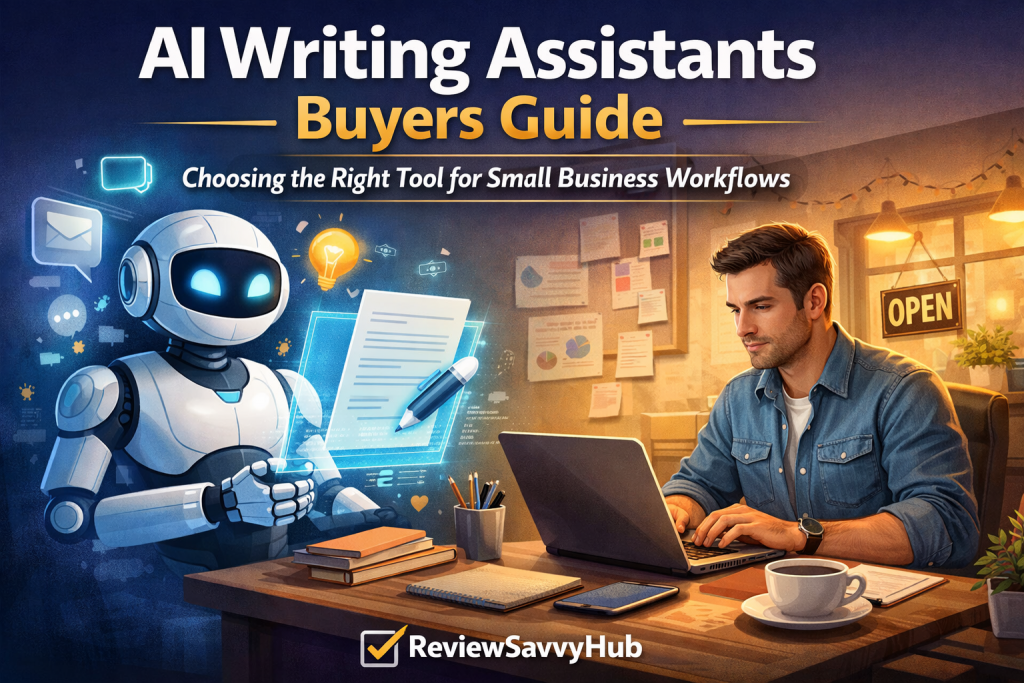
Decision Context — What This Guide Helps You Decide
This AI writing assistants buyers guide helps small business owners, freelancers, and solo operators decide whether an AI writing tool genuinely fits their day-to-day workflow — or simply adds noise.
AI writing assistants are now used for emails, proposals, website copy, internal documents, customer support replies, and marketing content. While many tools promise faster output and “human-like” writing, real-world value depends far more on alignment with business needs than on feature lists.
This guide exists to help buyers understand what AI writing assistants can realistically support in small business environments, where time, budget, and accountability matter more than experimentation. It avoids ranking products or promoting tools and instead focuses on decision clarity, limitations, and long-term suitability.
This AI writing assistants buyers guide is written for businesses that want assistance — not automation that replaces judgement, voice, or responsibility.
Buyer Reality Check — Why Many Small Businesses Abandon AI Writing Tools
Most small businesses do not stop using AI writing tools because the technology is weak. They stop because expectations are misaligned.
A common mistake is assuming that AI will produce ready-to-publish content with no oversight. In reality, most writing assistants excel at structure and speed but struggle with context, brand voice, and nuanced intent. When owners expect replacement rather than support, frustration follows.
Another issue is tool overload. Businesses often subscribe to multiple writing platforms with overlapping capabilities, increasing cost without improving outcomes. In many cases, a single well-understood tool would have delivered better results than several under-used subscriptions.
For small teams, value comes from clarity, not volume. This AI writing assistants buyers guide highlights why choosing less — but choosing correctly — often leads to better productivity.
Step One: Define What You Actually Need Help Writing
Before comparing any AI writing assistant, buyers should identify their primary writing tasks.
For many small businesses, writing needs fall into a few core areas: customer communication, internal documentation, basic marketing copy, and idea structuring. These tasks benefit from clarity, tone control, and adaptability — not creativity for its own sake.
Businesses that rely heavily on compliance, contracts, or sensitive messaging should be especially cautious. AI writing assistants can support drafting and summarisation, but final responsibility always rests with the human user.
Understanding whether you need speed, consistency, idea support, or tone refinement is the first step toward choosing the right category of tool.
Core Categories of AI Writing Assistants
This buyer’s guide focuses on types of writing tools, not specific products.
General-Purpose Writing Assistants
General AI writing assistants are flexible and accessible. They support a wide range of tasks, from emails to long-form drafts. Their strength lies in adaptability, but their weakness is generic output without guidance.
These tools work best when users actively edit, refine prompts, and apply judgement.
Marketing-Focused Writing Tools
Some writing assistants are designed specifically for marketing tasks such as ads, landing pages, and social posts. They prioritise templates and conversion-oriented language.
While useful for speed, these tools can encourage formulaic content if used without oversight. Small businesses should treat them as starting points, not final copy.
Workflow-Integrated Writing Tools
Certain AI writing assistants integrate directly into email clients, document editors, or project management systems. Their value lies in convenience and reduced context switching.
However, integration alone does not guarantee quality. Businesses should evaluate whether these tools genuinely improve workflow or simply add another layer of dependency.
Who Should Use What — Practical Buyer Guidance
Freelancers and solo operators benefit most from general-purpose writing assistants that adapt across tasks without locking them into rigid templates.
Small businesses with regular customer communication should prioritise tools that allow tone adjustment and contextual memory, ensuring responses remain consistent and professional.
Marketing-heavy teams may benefit from specialist tools, but only if brand voice guidelines are clearly defined and human review remains part of the process.
Businesses expecting AI to fully replace writing roles or eliminate review steps are likely to encounter disappointment.
Accuracy, Voice, and Responsibility
AI writing assistants do not understand intent. They predict language.
This distinction matters. Even when output sounds confident, it may misrepresent facts, oversimplify complex issues, or dilute brand voice. Responsibility for accuracy, tone, and appropriateness always remains with the business using the tool.
Effective use requires treating AI output as a draft — not a decision.
Final Buyer Verdict — Support Over Substitution
This AI writing assistants buyers guide is intended for small businesses that value clarity, consistency, and control over novelty or automation.
The right writing assistant supports thinking, reduces friction, and saves time — without erasing human judgement or accountability.
This guide does not promote tools or partnerships. Its purpose is to help buyers choose writing assistance that fits their workflow, scale, and responsibility level.
At ReviewSavvyHub, we believe AI should strengthen small businesses by supporting decisions — not replacing them.