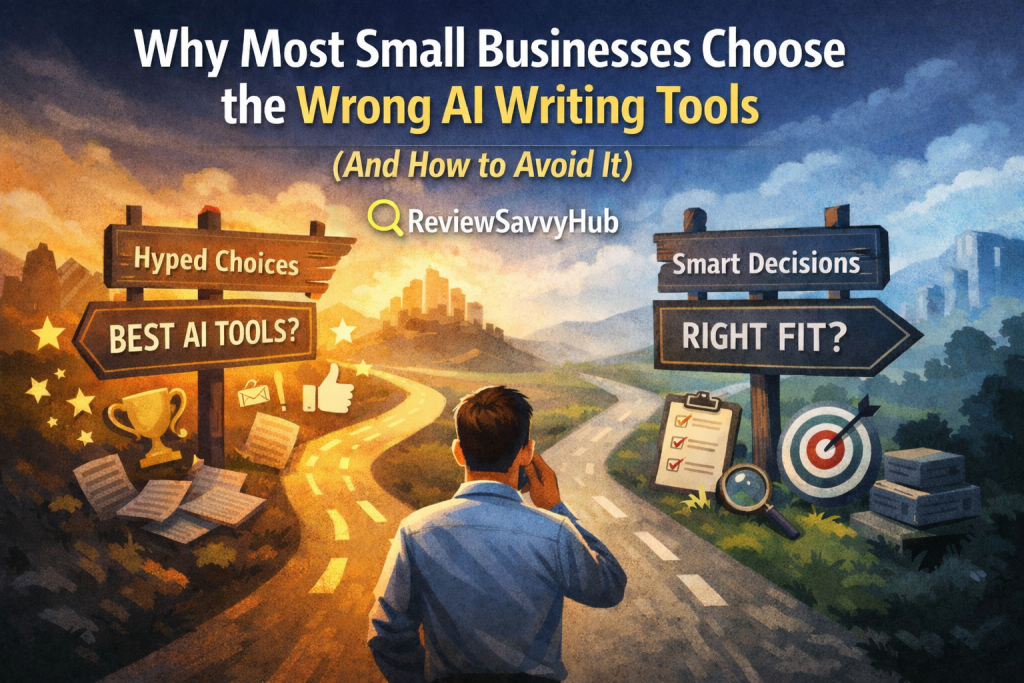
Small businesses rarely fail with AI writing tools because the tools are bad.
They fail because the decision process is broken. Understanding these ai writing tool mistakes is crucial for success. Recognising common ai writing tool mistakes can significantly improve outcomes.
The market is flooded with “best AI tools” lists, rankings, and confident recommendations. On the surface, this feels helpful. In practice, it pushes businesses toward choices that look impressive but do not fit their actual workflows.
Moreover, avoiding ai writing tool mistakes helps streamline workflows and enhances productivity.
By understanding ai writing tool mistakes, businesses can navigate the market more effectively.
This article explains why wrong choices happen — and how small businesses can avoid them without chasing trends or hype.
The Problem Is Not the Tool — It’s the Framing
Avoiding Common AI Writing Tool Mistakes
Most AI writing tools are marketed as universal solutions. The message is subtle but consistent: one tool can do everything.
That framing is misleading.
Writing is not one task. It includes operational communication, marketing copy, long-form content, internal documentation, and strategic thinking. Each of these requires different levels of judgment, structure, and consistency.
When all writing is treated as one problem, tool selection becomes guesswork.
Identifying these ai writing tool mistakes is essential for making informed selections.
These ai writing tool mistakes can lead to unexpected challenges in content creation.
Mistake #1: Starting With “Best Tools” Lists
Rankings simplify complex decisions into linear comparisons. They assume that tools are interchangeable and that one option can be “best overall.”
In reality:
- Tools are built for different roles
- Strengths in one context are weaknesses in another
- Rankings hide trade-offs instead of explaining them
Small businesses following rankings often end up paying for features they never use — or missing capabilities they actually need.
Mistake #2: Confusing Writing Assistance With Decision-Making
Recognising these ai writing tool mistakes enhances overall content quality.
AI tools are excellent at accelerating drafts, cleaning language, and generating variations. What they cannot do reliably is decide what should be written and why.
Many businesses expect AI to replace judgment rather than support it. When the output feels generic or misaligned, the tool is blamed — even though the real issue is misplaced responsibility.
AI assists execution.
Human judgment defines intent.
Addressing common ai writing tool mistakes can prevent costly errors.
Mistake #3: Choosing Tools Based on Future Fears
Another common pattern is overbuying “just in case.”
Businesses worry about scaling, missing features, or outgrowing tools. Vendors amplify this anxiety by positioning advanced plans as safety nets rather than necessities.
The result is premature complexity:
- Paying for team features while working solo
- Subscribing to automation before processes exist
- Managing systems that slow work instead of speeding it up
Right tools are chosen for current needs, not imagined futures.
Mistake #4: Treating All AI Writing Tools as the Same Category
Awareness of ai writing tool mistakes enables better decision-making processes.
Not all AI writing tools serve the same purpose.
Some are designed for thinking support and exploration. Others focus on polishing routine writing. Some optimise marketing and SEO performance. Others organise workflows without generating content at all.
Comparing these tools directly leads to confusion because they solve different problems. Capability fit matters more than feature count.
How to Avoid These Mistakes (Without Overthinking)
Small businesses do not need complex frameworks to choose better tools. They need clarity.
Learning from past ai writing tool mistakes can lead to improved strategies.
Three simple shifts make a measurable difference:
The key to success lies in avoiding ai writing tool mistakes through clear objectives.
- Define the task first
Be specific about what needs support — not “writing,” but a clear activity. - Understand the tool’s role
Is it assisting thinking, accelerating writing, optimising performance, or managing process? - Decide with limits in mind
A good tool explains what it does not do as clearly as what it does.
When decisions are made this way, tools stop competing for attention and start fitting into workflows naturally.
Where This Leads Next
Ultimately, recognising ai writing tool mistakes empowers businesses to thrive.
By heeding these insights on ai writing tool mistakes, companies can elevate their content efforts.
Understanding why mistakes happen is the first step. The next step is choosing tools calmly, without pressure, rankings, or exaggerated claims.
For readers who want a deeper, structured breakdown of AI writing tools — including categories, trade-offs, and real-world suitability — our AI Writing Assistants Buyer’s Guide explores this process in detail.
In conclusion, avoiding common ai writing tool mistakes is vital for long-term success.
Transparency Note
This article is written to support informed decision-making. We do not sell rankings or accept paid placements. Some links on ReviewSavvyHub may be affiliate links, but this never affects our analysis or conclusions.