Opinion & Insight | ReviewSavvyHub
Awareness Training Liability Starts Before Systems Fail
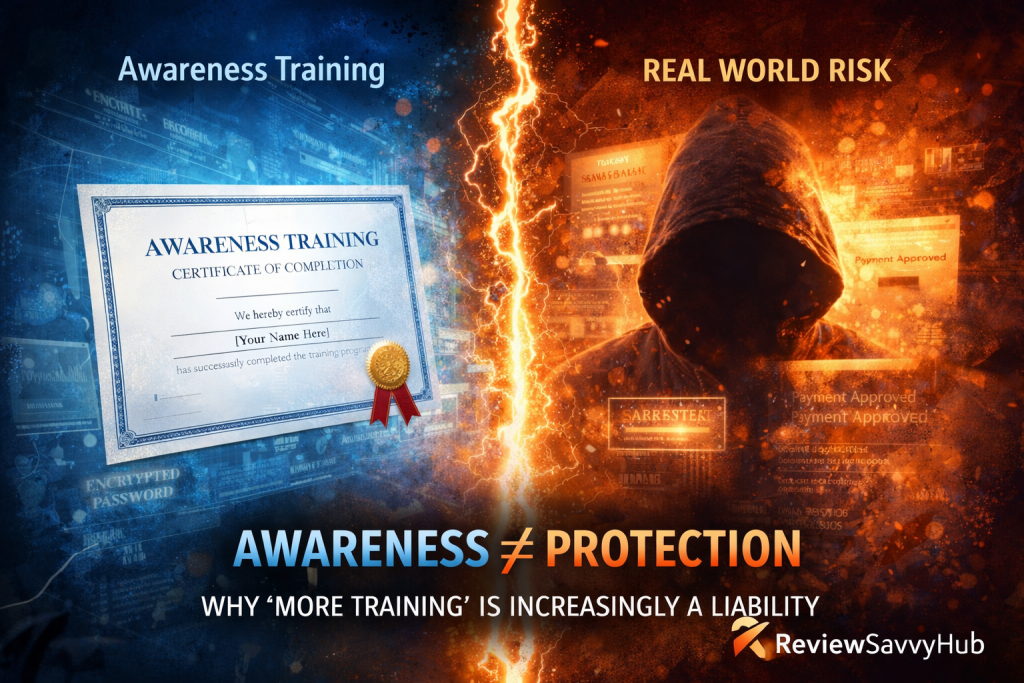
Awareness training liability begins when organisations assume that awareness equals protection.
When a breach occurs, a fraudulent payment is approved, or a serious operational mistake costs millions, the response is almost always the same: more awareness training.
It feels responsible. It sounds proactive.
But in reality, awareness training liability is growing quietly inside organisations.
Systems often work as designed.
People do not — especially under pressure.
The Comfort Illusion Created by Awareness Training
Awareness training gives leadership a sense of psychological closure. Once modules are completed, certificates issued, and dashboards updated, risk appears managed. Compliance looks strong. Documentation is complete.
This is precisely where awareness training liability starts to form.
Employees may recognise threats in theory, but recognition does not equal correct action under pressure. Awareness builds familiarity with concepts, not reliability in behaviour. When real incidents unfold, the same patterns repeat themselves: hesitation, blind compliance, rushed decisions, and misplaced confidence.
The organisation feels prepared. The reality remains unchanged.
Why Awareness Training Liability Emerges Under Pressure
Human decision-making does not remain stable across conditions. Under urgency, attention narrows. Under authority, doubt is suppressed. Under fear, analysis degrades. Fatigue further weakens resistance.
Most awareness programmes are designed for calm, ideal environments. Real-world incidents are noisy, ambiguous, emotionally charged, and time-constrained.
This mismatch explains why awareness training liability persists even in highly trained organisations. Employees are taught what to look for, but not conditioned on how to decide when multiple pressures collide at once.
They are not careless.
They are cognitively overloaded.
The Knowledge–Action Gap Awareness Cannot Close
One of the most dangerous assumptions in organisational learning is that knowing automatically leads to doing.
People often know the correct response. They know verification steps exist. They know escalation is encouraged. They know shortcuts introduce risk.
Yet awareness training liability continues because knowledge alone does not become reflex. Under pressure, the brain prioritises speed, hierarchy, and social harmony. Awareness improves recognition, but recognition alone collapses when time is limited and stakes feel high.
This gap between knowledge and action is where most failures quietly originate.
When Awareness Training Liability Turns Into Overconfidence
In some environments, awareness training liability actively increases risk.
Employees who believe they are well trained may trust their instincts too much. They assume they can quickly identify manipulation. They skip verification steps they intellectually understand. Confidence replaces caution.
This overconfidence is subtle but dangerous. The organisation believes it is protected. The employee believes they are prepared. Reality does not change.
Awareness training liability thrives in this space between perceived readiness and actual decision behaviour.
What Actually Reduces Awareness Training Liability
Reducing awareness training liability requires a shift away from information delivery and toward behavioural conditioning.
Effective learning environments expose people to realistic pressure. They train decision-making under constraints. They reward escalation over speed. They make consequences visible rather than abstract. They normalise slowing down even when urgency feels justified.
In short, they build decision reflexes instead of informational confidence.
Why Awareness Training Liability Matters Now
As organisations automate more processes, the remaining human decision points become fewer but far more critical.
Errors propagate faster than ever. A single approval, click, or assumption can cascade across systems before anyone intervenes. In this environment, awareness training liability is no longer theoretical. It is operational, measurable, and costly.
Relying on awareness alone places an unrealistic burden on human judgement at precisely the moments it is least reliable.
The ReviewSavvyHub Judgement
Awareness training is not useless.
But awareness training liability becomes unavoidable when awareness is treated as a safeguard.
Organisations that rely on awareness alone are not reducing risk. They are documenting it.
Real protection begins when learning shifts from telling people what the right action is, to conditioning how decisions are made under pressure — consistently, predictably, and without relying on hope.
Transparency Note
This article reflects ReviewSavvyHub’s independent analytical opinion.
It examines organisational learning and risk through a decision-focused lens and does not provide medical, psychological, or legal advice.