Opinion & Insight | ReviewSavvyHub
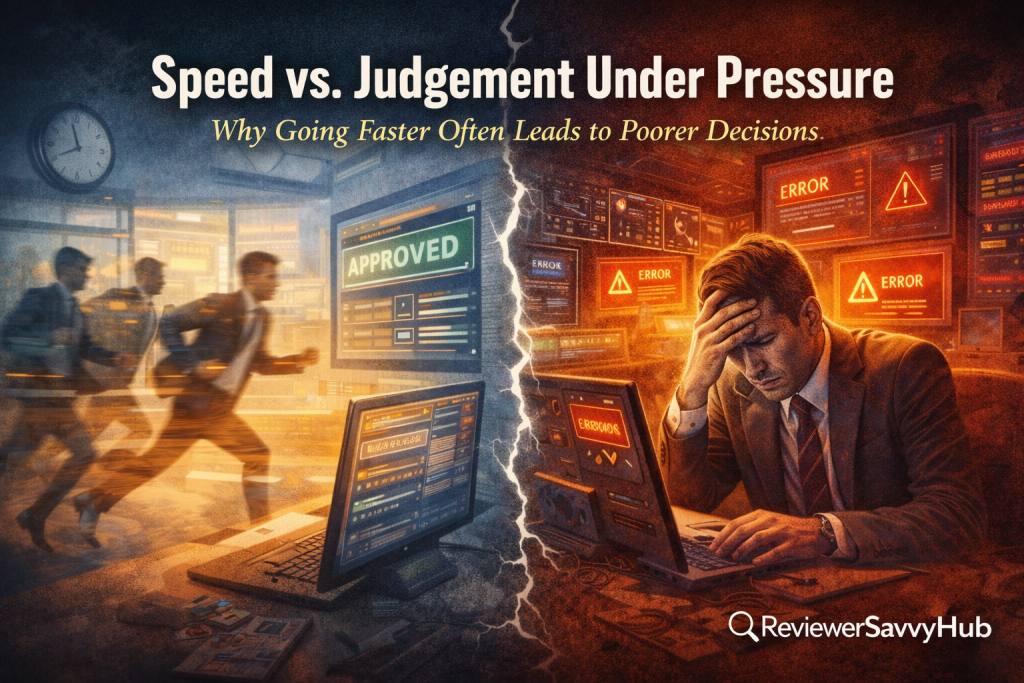
Speed vs judgement is the hidden tension shaping how modern organisations operate under pressure. While many workplaces prioritise rapid execution, the balance of speed vs judgement determines whether an organisation is truly efficient or merely rushing toward failure.”
But this obsession comes at a cost.
When speed becomes the default rather than a deliberate choice, judgement begins to erode. Decisions are made earlier than they should be, with less context than required, and with little room for doubt. What appears efficient on the surface often hides structural fragility underneath. Most high-impact organisational failures do not begin with bad intent; they begin with decisions made too quickly—under the assumption that moving fast is always safer than slowing down. It rarely is.
The ReviewSavvy Insight: Neuro-Learning Perspective
According to The Neuro-Learning Framework™, high-stakes judgement requires the activation of analytical brain regions that are naturally slower than impulsive response centers.
- Speed Pressure: Forces the brain into “Cognitive Shortcutting.”
- Judgement: Requires “Cognitive Friction” to validate facts.
- The Risk: When speed is unexamined, the brain prioritises completion over correctness.
How Speed Pressures Change Human Cognitive Decision Making
Human cognition is not neutral to time pressure. When decisions must be made quickly, the brain does not simply accelerate — it switches mode. Cognitive shortcuts take over, and the following shifts occur:
- Nuance fades and complexity is ignored.
- Verification starts to feel unnecessary or burdensome.
- Escalation feels like a delay rather than a safety net.
- Familiar patterns and biases replace deep analysis.
- Action becomes more important than understanding.
Under speed pressure, people rely on habit, authority cues, and surface signals rather than careful reasoning. What often looks like confidence is, in reality, cognitive shortcutting. Organisations believe they are optimised, when in fact they may be training their people to bypass judgement altogether. Speed does not just compress time; it compresses thinking.
Why Fast Decisions Feel Right — The Deception of Decisiveness
Speed offers psychological comfort. Acting quickly feels decisive. It reduces uncertainty. It signals competence to peers and superiors. In fast-moving environments, hesitation is frequently misinterpreted as weakness. This makes speed emotionally rewarding, but that reward is deceptive.
Many damaging decisions are not reckless; they are reasonable decisions made too early, with incomplete information and without verification. Speed converts uncertainty into action before doubt has the chance to surface. Once a fast decision is made, automated workflows propagate actions across teams before reflection can intervene. As we discussed in our analysis of Systemic Failure Patterns, by the time concerns arise, reversal is often costly — or impossible.
The Illusion of Efficiency vs Organisational Effectiveness
Organisations often confuse throughput with effectiveness. Smooth workflows and rapid approvals create the impression of a healthy system. Yet efficiency metrics rarely measure decision quality.
- A fast approval that enables fraud looks identical to a fast approval that enables success.
- Speed hides fragility until it is too late to contain it.
This is where speed vs judgement shifts from a productivity concern into a structural organisational risk. In many organisations, speed is celebrated because its failures are delayed and difficult to attribute. By the time damage becomes visible, the original decision is long forgotten.
Strategic Resilience: When Slowing Down Becomes a Strength
Resilient organisations are not slow everywhere; they are deliberate where it matters. They understand that disciplined decision-making is a competitive advantage. To achieve this, they:
- Introduce deliberate friction at critical decision points.
- Normalise pauses without penalising caution or doubt.
- Reward verification even when urgency feels justified.
- Make escalation acceptable rather than embarrassing.
In such environments, slowing down is risk control. Speed becomes a tool — not a value.
Why Modern Technology Often Intensifies Decision Risk
Automation is frequently introduced to increase speed. Faster systems promise efficiency, but without deliberate cognitive design, automation often intensifies the very risks organisations hope to eliminate.
Alerts demand immediate action. Dashboards encourage instant response. Automated approvals reduce the perceived need for human judgement. Technology does not remove pressure; it redistributes it. When systems execute instantly, the cost of a rushed human decision increases dramatically. Mistakes travel faster. Recovery becomes harder.
The problem is not speed itself. The problem is unexamined speed at human decision points.
The ReviewSavvyHub Final Judgement
Speed is not the enemy of organisations. Unquestioned speed is.
When speed replaces judgement, organisations trade resilience for momentum. The organisations that endure are not the fastest; they are the ones that know when to slow down. In a world where systems execute instantly, the real competitive advantage is not speed — it is disciplined decision-making under pressure.
Read Next: Why Phishing Simulations Fail – A Study in Decision Fatigue
Transparency Note: This article reflects ReviewSavvyHub’s independent analytical opinion. It examines organisational behaviour and decision risk through a judgement-focused lens and does not provide legal, medical, or psychological advice.