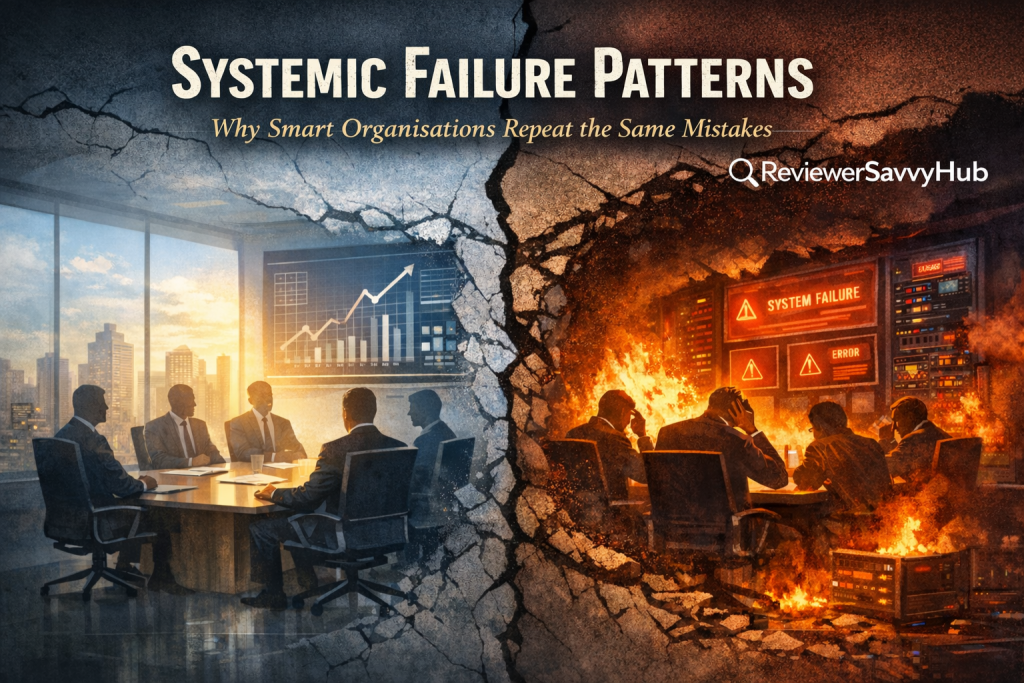
Why Smart Organisations Repeat the Same Mistakes
Opinion & Insight | ReviewSavvyHub
Systemic failure patterns explain why even the smartest organisations repeat the same mistakes.
Most organisations do not fail because they lack intelligence, talent, or technology. On paper, many are exceptionally well-designed. They employ capable people, invest heavily in systems, and follow industry best practices.
Yet the same categories of failure keep returning.
A fraud slips through despite strong controls.
A system outage escalates into a crisis.
A single rushed decision triggers cascading consequences.
Post-incident reviews are conducted. Reports are written. Controls are updated. And still, months or years later, the organisation finds itself facing a familiar problem wearing a slightly different mask.
This repetition is not accidental.
It is systemic.
The Illusion of Learning After Failure
After a major incident, organisations often convince themselves that learning has occurred. New policies are published. Additional approvals are introduced. Training sessions are scheduled.
What usually changes is documentation — not cognition.
Employees can often recite the updated rules, yet remain unprepared for the next real-world decision under pressure. They know what the policy says, but not how to reason when the situation does not fit neatly into the policy’s wording.
This creates an illusion of progress. Leaders see activity and assume improvement. In reality, the underlying decision patterns remain untouched.
Failure returns because the organisation learned what happened, not why people decided the way they did.
Why Smart People Make Predictable Mistakes
In high-stakes environments, decision-making does not operate in a neutral space. It is shaped by psychological forces that become stronger as pressure increases.
Urgency compresses thinking. Authority cues discourage questioning. Familiar processes feel safer than uncertainty. Escalation is avoided because it risks appearing incompetent or disruptive.
These behaviours are not signs of poor judgement. They are natural human responses.
The real risk emerges when organisational systems silently assume that people will consistently override these instincts — especially during moments of stress, fatigue, or ambiguity.
When systems rely on exceptional judgement as a default requirement, failure becomes a matter of time.
Normalisation of Risk Inside Organisations
One of the most dangerous systemic patterns is the gradual normalisation of risk.
Shortcuts that work once begin to feel acceptable. Temporary exceptions quietly become standard practice. Workarounds are rewarded because they preserve speed and output.
Over time, these behaviours lose their sense of risk entirely. They become routine. New employees inherit them without questioning their origin or implications.
By the time a failure occurs, the actions that caused it feel normal — even responsible — to those involved. From their perspective, nothing unusual happened. The system simply “unexpectedly failed.”
This is how organisations drift into danger without realising it.
Why Controls Alone Don’t Break the Pattern
When repeated failures occur, the instinctive response is often to add more controls: more alerts, more approvals, more checklists.
Ironically, this can increase risk rather than reduce it.
Excessive controls encourage circumvention. Alerts become background noise. Checklists become rituals completed mechanically, without reflection. The system grows heavier, while genuine judgement weakens.
Controls can only manage risk when they support thinking. When they attempt to replace thinking, they invite avoidance.
The result is a system that looks robust on paper but becomes brittle in practice.
The Decision Environment Beneath Repeated Failures
When organisations experience the same type of failure again and again, the root cause is rarely a lack of rules, training, or technology.
It is the decision environment.
An environment that rewards speed over reflection.
An environment that discourages challenge and escalation.
An environment where compliance is measured, but judgement is invisible.
As long as this environment remains unchanged, failures will not disappear. They will simply evolve.
The ReviewSavvyHub Judgement
Systemic failures persist because organisations focus on fixing outcomes rather than redesigning decision conditions.
Smart organisations do not fail because they lack intelligence. They fail because their systems quietly shape behaviour in ways leadership no longer notices.
Breaking failure patterns does not begin with more policies or controls. It begins with understanding how pressure, incentives, and structure influence judgement at the moments that matter most.
The organisations that endure are not the ones that react fastest after failure.
They are the ones that recognise why failure keeps returning — and address it at the cognitive level.
Transparency Note
This article reflects ReviewSavvyHub’s independent analytical opinion. It examines organisational decision patterns and systemic risk through a judgement-focused lens. It does not provide legal, medical, or psychological advice.