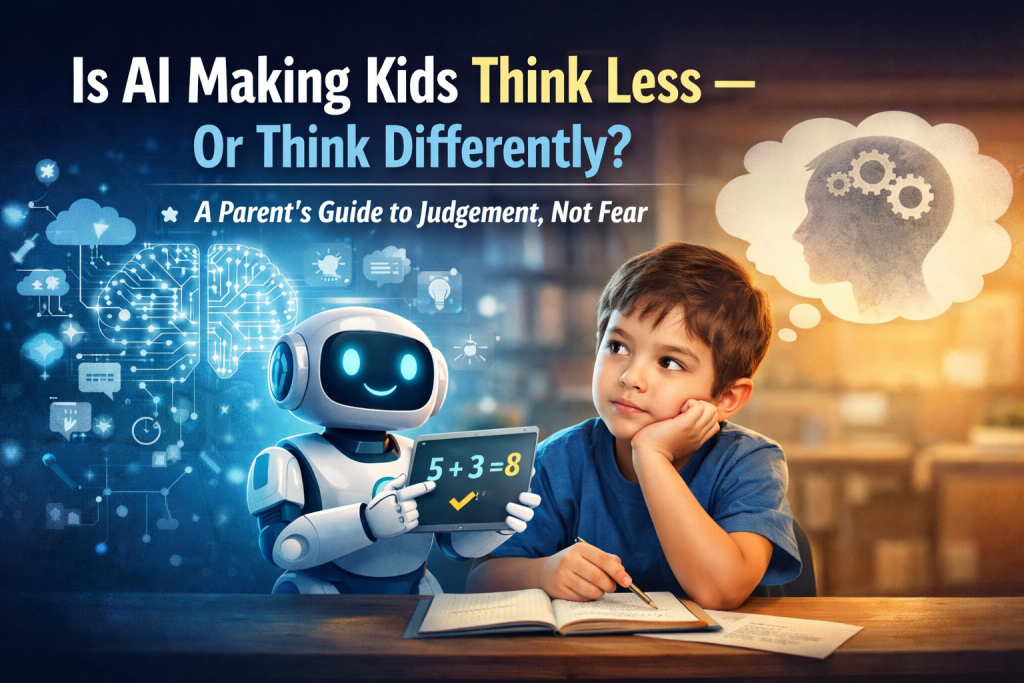
A Parent’s Guide to Judgement, Not Fear
Is AI making kids think less — or is it changing how children think, learn, and form judgement in a world shaped by intelligent tools?
Artificial intelligence has entered children’s lives quietly. It is not arriving as a single device or app, but as a layer underneath homework help, learning games, reading assistants, voice answers, and “smart” recommendations. Many parents sense a tension they struggle to articulate.
If AI can answer instantly, explain endlessly, and guide every step, what happens to a child’s ability to think for themselves?
This concern is valid. But the real issue is not whether AI is present. It is how AI changes the process of thinking.
AI does not automatically make children think less. In some cases, it helps them think better. In others, it quietly replaces the very struggle that learning depends on. Understanding the difference is the key to making good decisions.
Thinking Is Not Output — It Is Effort
Children do not learn by receiving answers. They learn by wrestling with uncertainty, making mistakes, and slowly constructing understanding. This effort is not a side effect of learning; it is the engine of it.
When a child asks a question and immediately receives a polished answer, something subtle changes. The discomfort of not knowing disappears. The mental pause where curiosity, hypothesis, and reasoning would normally occur is skipped.
AI accelerates outcomes, but learning depends on process. The risk is not that children get help. The risk is that help arrives too early, too smoothly, and too completely.
This is where parents often feel uneasy, even if they cannot explain why.
How AI Can Support Thinking
AI can be a powerful cognitive support when it operates as a guide rather than a replacement.
When children use AI to:
- ask follow-up questions,
- request explanations in simpler language,
- explore alternative viewpoints,
- reflect on why an answer is correct,
AI extends thinking rather than short-circuiting it.
In these cases, the child remains cognitively active. They are still forming judgments, evaluating ideas, and connecting concepts. AI becomes a scaffold, not a crutch.
Used this way, AI can increase curiosity, confidence, and independent learning — especially for children who struggle with traditional instruction.
When AI Starts Thinking Instead of the Child
Problems arise when AI shifts from assistance to delegation.
If a child:
- asks for direct answers without attempting the problem,
- copies explanations without understanding them,
- relies on AI to decide what is correct or important,
- avoids effort because AI makes it unnecessary,
thinking slowly erodes.
This is not because AI is “bad,” but because learning without effort produces shallow understanding. Over time, children may become efficient at producing results while losing comfort with uncertainty, confusion, and trial-and-error.
This pattern looks like productivity, but it weakens judgement.
The Difference Parents Often Miss
Most debates frame the question incorrectly: Is AI good or bad for kids?
The better question is: Where does thinking happen?
If thinking happens before AI responds, learning is strengthened.
If thinking happens after AI responds, learning weakens.
If thinking does not happen at all, dependency forms.
The same tool can produce very different outcomes depending on timing, context, and parental boundaries.
Why Fear-Based Restrictions Don’t Work
Many parents respond to uncertainty by banning or severely restricting AI. This feels protective, but it often backfires.
Children will encounter AI anyway — at school, through friends, or later without guidance. When AI is treated as forbidden, it is not understood. When it is framed as magical or dangerous, judgement is never built.
Avoidance delays the problem rather than solving it.
What children need is not isolation from AI, but literacy about how to use it responsibly.
Building Judgement Instead of Dependence
Judgement develops when children are taught to pause, question, and reflect.
Healthy AI use for children includes:
- asking children to explain their own reasoning before checking AI,
- using AI to compare answers, not supply them,
- discussing when AI might be wrong or incomplete,
- setting rules around when AI is allowed during learning.
These practices shift AI from authority to assistant. They keep thinking anchored in the child, not the tool.
The goal is not to slow children down unnecessarily, but to preserve productive friction — the mental effort that makes learning stick.
Thinking Differently Is Not Thinking Less
AI changes how thinking happens. Some skills become less necessary, while others become more important.
Children may rely less on memorisation, but need stronger judgement. They may calculate less, but reason more. They may write with assistance, but must learn to evaluate meaning, intent, and accuracy.
This is not cognitive decline. It is cognitive redistribution.
The danger lies not in change, but in unexamined change.
Final ReviewSavvyHub Judgement
AI is not making children think less by default. It is changing where thinking happens.
When AI replaces effort, judgement weakens.
When AI supports effort, judgement strengthens.
Parents do not need to fear AI. They need to manage when and how it enters the learning process. The task is not to remove AI from children’s lives, but to ensure that thinking remains central.
Education has always evolved with tools. What matters is whether tools serve the mind — or quietly replace it.
Transparency Note
This analysis is independent, unsponsored, and tool-agnostic. It is based on established research in cognitive development, educational psychology, and behavioural technology use. The article represents an original judgement-based synthesis intended to help parents make informed decisions, not to promote or oppose specific products.