The Hidden Decision Behind AI Adoption
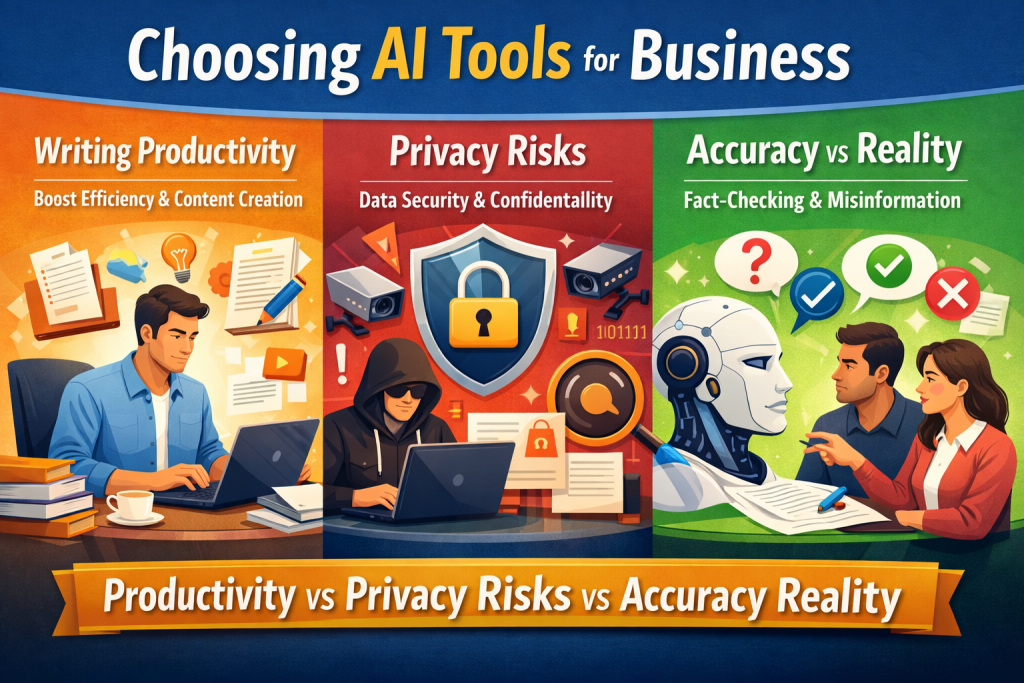
Choosing AI tools for business has become a strategic decision as organisations increasingly integrate AI into daily workflows to achieve faster writing, automated operations, and measurable productivity gains. However, the reality of AI adoption is rarely aligned with marketing narratives. Many organisations encounter unexpected trade-offs including data exposure risks, inconsistent output reliability, and operational dependence on tools that may perform differently under real business pressure compared to controlled demo environments.
This buyers guide examines AI tools through three interconnected decision lenses that directly influence business outcomes: writing productivity efficiency, privacy and data control implications, and accuracy reliability (including hallucination risk). Rather than presenting a feature-driven tool list, the guide provides a structured understanding of how these dimensions interact, where common misconceptions exist, and how small businesses can approach AI adoption with informed decision clarity instead of assumption-based optimism.
Context & Background
The rapid expansion of AI tools has created a highly fragmented decision landscape for small businesses. While vendors promote automation efficiency and productivity gains, the practical reality involves navigating trade-offs between performance, data governance, and reliability. Many organisations adopt AI solutions based on feature availability rather than operational suitability, resulting in workflow inconsistencies and hidden risks that only emerge after integration.
The current market dynamic is characterised by aggressive freemium positioning, overlapping tool capabilities, and varying transparency around data handling practices. This environment makes it difficult for small businesses to distinguish between tools that deliver sustainable operational value and those that introduce long-term compliance, accuracy, or strategic dependency challenges.
What This Buyers Guide Covers
This buyers guide provides a structured evaluation framework for selecting AI tools across three critical business dimensions: writing productivity effectiveness, data privacy exposure, and accuracy reliability. Instead of focusing on isolated feature comparisons, the guide explains how these dimensions interact within real operational workflows and influence long-term decision quality.
The purpose is to help small businesses move beyond feature-driven selection toward informed adoption strategies that consider practical performance behaviour, risk visibility, and governance readiness. By framing AI tools within this decision architecture, the guide enables readers to evaluate solutions based on operational fit rather than marketing positioning.
Real-World Risk & Performance Behaviour
AI tools often demonstrate impressive performance in controlled demonstrations but behave differently when integrated into real operational workflows. Small businesses may encounter output inconsistency, contextual misunderstanding, and over-confidence in generated content, particularly when tasks involve domain-specific nuance or sensitive decision contexts.
Privacy exposure represents another practical concern, as data entered into AI systems may be processed through cloud infrastructure with varying levels of transparency. Additionally, hallucination risk introduces reliability challenges where confidently presented outputs may contain inaccuracies, requiring verification workflows that reduce perceived productivity gains.
The Marketing Claim Trap
AI vendors frequently position tools using broad productivity promises such as “instant content creation,” “secure AI,” and “human-level accuracy.” While these claims may reflect technical potential, they often overlook operational realities including workflow integration complexity, configuration requirements, and data governance limitations.
Freemium strategies can further amplify expectation gaps by showcasing high-capability demonstrations while restricting critical functionality behind subscription tiers. This creates an adoption environment where businesses may underestimate long-term cost, risk exposure, and verification workload necessary to maintain reliable AI-assisted operations.
Escape Strategy: How Small Businesses Avoid AI Adoption Traps
Effective AI adoption requires a governance-first mindset rather than feature-first enthusiasm. Small businesses can reduce exposure to privacy risk and reliability issues by implementing prompt discipline, verification workflows, and clear boundaries regarding sensitive data usage. Treating AI as an assistive layer rather than a decision authority helps maintain operational control and prevents over-dependence on automated outputs.
A practical escape strategy also involves staged tool integration, where businesses evaluate AI performance within low-risk workflows before scaling usage. Establishing human review checkpoints and maintaining documentation of AI-assisted decisions further strengthens accountability and ensures that productivity gains do not compromise accuracy or compliance.
Claims vs Reality Snapshot
AI marketing narratives frequently emphasise speed, automation, and near-human intelligence, yet operational reality reveals a more nuanced performance landscape. Writing tools can accelerate drafting but often require editorial oversight, privacy assurances may depend on configuration and plan tier, and accuracy reliability remains contingent on context complexity and verification practices.
The gap between claim and reality does not indicate tool failure but highlights expectation misalignment. Businesses that recognise AI as a probabilistic assistant rather than a deterministic system are better positioned to extract value while mitigating risk. This perspective enables balanced adoption strategies grounded in realistic capability assessment.
Strategic Insight: The Real Cost Isn’t the Subscription — It’s the Verification Burden
Small businesses typically evaluate AI tools through visible costs: subscription fees, seat pricing, and plan limits. However, the more durable cost often appears after adoption — the verification burden. When outputs require frequent checking for accuracy, tone, brand alignment, and legal risk, AI stops being “automation” and becomes a new operational layer that must be managed. If this layer is not designed intentionally, businesses may trade time savings for cognitive fatigue and decision uncertainty.
Privacy risk and hallucination risk are not separate problems — they create pressure on the same operational system. The more sensitive the business context, the more verification is required, and the less data can safely be shared with tools. This means “AI value” is not a feature question; it is a workflow architecture question. The winning setup is the one that reduces verification effort while improving output usefulness under real business constraints.
SWOT Analysis: AI Tools for Small Business Adoption
Strengths
Accelerates drafting and ideation, improves speed of routine writing tasks, and can support lightweight automation across customer emails, internal docs, and marketing content — especially when workflows are structured and verification is built in.
Weaknesses
Output reliability varies by context, hallucination risk remains present, and privacy assurances differ across vendors and tiers. Without governance, teams may develop over-reliance and inconsistent quality control.
Opportunities
Businesses can gain competitive efficiency by standardising prompts, building reusable content systems, adopting privacy-safe workflows, and using AI for drafting while reserving humans for judgement, compliance, and high-stakes decisions.
Threats
Data exposure incidents, regulatory tightening, vendor lock-in, and reputational damage from inaccurate outputs can undermine trust. Teams may also face “productivity illusion” where AI increases volume but decreases clarity and accountability.
PESTLE Analysis: AI Tools in Small Business Context
Political
Governments are increasingly focusing on AI governance and accountability frameworks, creating an environment where businesses must remain aware of evolving compliance expectations around automated decision support systems.
Economic
AI tools can reduce labour intensity for routine tasks but may introduce hidden subscription scaling costs and verification overhead that influence long-term ROI.
Social
Workforce trust, skill dependency, and customer perception of AI-generated communication shape how businesses integrate automation without eroding authenticity.
Technological
Rapid model evolution improves capabilities but creates instability in performance expectations, feature continuity, and integration reliability.
Legal & Environmental
Data protection laws, intellectual property concerns, and sustainability debates around compute infrastructure introduce additional governance considerations that businesses must monitor when scaling AI usage.
Accuracy & Limitations
AI tool performance is inherently probabilistic, meaning outputs reflect statistical pattern generation rather than deterministic factual guarantees. Accuracy may vary based on prompt clarity, domain specificity, and contextual complexity. Consequently, small businesses should interpret AI outputs as drafts requiring validation rather than final authoritative content.
Limitations also arise from privacy constraints that restrict data sharing, feature differences across pricing tiers, and integration variability across workflows. Additionally, rapid model updates can change tool behaviour over time, creating a moving reliability baseline that businesses must monitor through ongoing verification and process adaptation.
Audience Reality
AI tools are particularly beneficial for small businesses seeking drafting acceleration, operational assistance, and ideation support where human review remains feasible. Organisations with structured workflows, clear governance boundaries, and low-sensitivity data environments can extract measurable value while maintaining acceptable risk exposure.
Conversely, businesses operating in highly regulated environments, handling sensitive client data, or relying on precision-critical outputs may encounter limitations that reduce AI’s immediate utility. In such contexts, adoption must be cautious, verification-heavy, and aligned with compliance obligations rather than productivity expectations alone.
Final Verdict
AI tools can provide meaningful productivity advantages for small businesses when positioned as assistive drafting and ideation systems rather than autonomous decision engines. The practical value of these tools is determined less by feature breadth and more by how effectively organisations manage verification workflows, privacy boundaries, and expectation alignment.
Businesses that approach AI adoption through a workflow architecture lens — balancing writing efficiency, privacy governance, and accuracy verification — are more likely to achieve sustainable benefit while avoiding operational and reputational risk. The optimal decision is therefore not tool selection alone but the design of an adoption framework that preserves human judgement alongside automated assistance.
Transparency Note
This analysis is independently developed using publicly observable product behaviour, workflow evaluation principles, and strategic assessment frameworks. The guide does not rely on vendor sponsorship or promotional influence and reflects an evidence-informed perspective intended to support balanced decision-making.