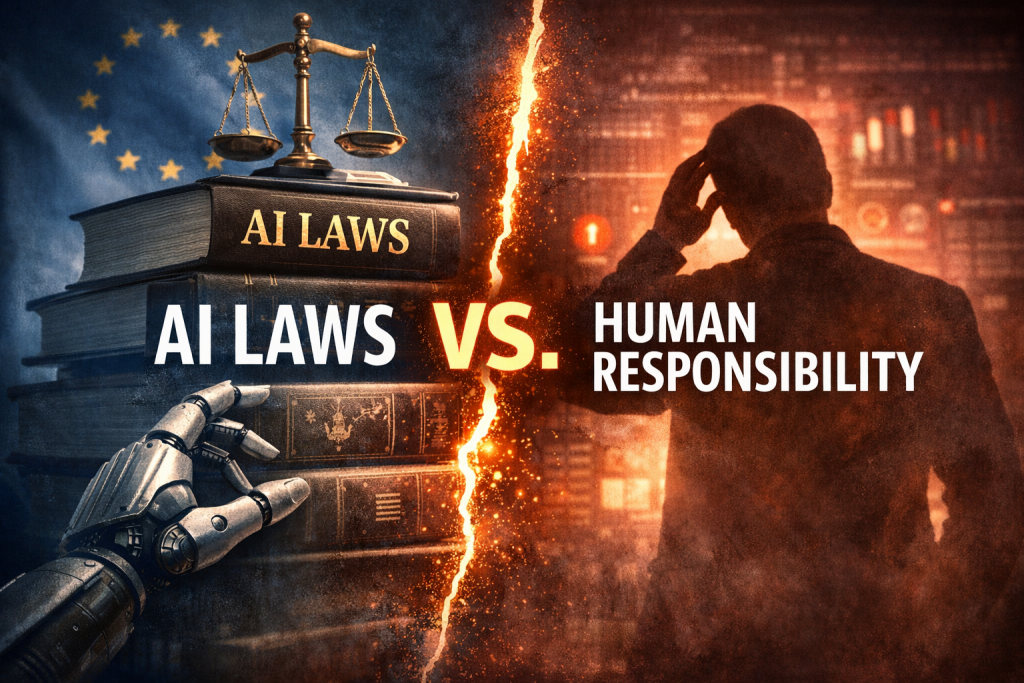
What global AI legislation reveals — and what it quietly avoids
AI laws and human responsibility are increasingly moving in opposite directions. Around the world, governments are introducing new regulations to control artificial intelligence, yet the question of who remains accountable for AI-assisted decisions is becoming harder to answer.
This shift is not happening because laws are absent, but because regulation often arrives without clear expectations of moral ownership. As AI systems become embedded in everyday decision-making, responsibility is increasingly framed as a technical matter rather than a human one.
The result is a growing distance between those who design, deploy, and approve AI systems, and the real-world consequences those systems create. This distance is subtle, procedural, and often legally defensible — but ethically unresolved.
What Is Actually Happening
Artificial intelligence is no longer experimental.
It now influences who gets hired, who receives credit, who is flagged as a risk, what content is removed, how surveillance operates, and how decisions scale across entire populations.
Governments feel pressure to act. Citizens demand safeguards. Institutions seek certainty.
So laws appear.
But most of these laws are designed to regulate systems, not decision-makers. They define categories, thresholds, and acceptable use. They describe risk levels, prohibited practices, and compliance obligations.
What they rarely confront directly is the central question:
Who is morally responsible when an AI-assisted decision causes harm?
Regulation Without Ownership
Across jurisdictions, AI legislation follows a familiar structure.
Systems are assessed.
Risks are classified.
Compliance is documented.
Human oversight is mentioned — sometimes repeatedly. But oversight is often treated as a feature rather than a duty. A design requirement, not an obligation to exercise judgement.
Responsibility becomes shared, distributed, and procedural.
And when responsibility is distributed too widely, it quietly disappears.
No one denies involvement, yet no one fully owns the outcome. Approval happens, but accountability becomes blurred.
This growing gap between AI laws and human responsibility is not a technical failure, but a human one rooted in how judgement is quietly delegated to systems.
Why Laws Gravitate Toward Systems, Not Humans
This imbalance is not accidental.
It is easier to regulate technology than behaviour.
Easier to audit systems than cultures.
Easier to measure compliance than conscience.
Laws are written in the language of safety, efficiency, and risk mitigation. Moral language is avoided because it is difficult to enforce.
But decisions influenced by AI are not neutral. They affect people directly — their livelihoods, freedoms, and dignity.
When responsibility is framed as a technical requirement, ethical consequences are reduced to secondary effects.
The Comfort of Legal Distance
One unintended effect of AI regulation is psychological.
Once a system is certified, audited, or approved, decision-makers often feel protected — not morally, but procedurally.
Language shifts.
“The system flagged it.”
“The model recommended it.”
“We followed the framework.”
Each sentence is technically correct. Each creates distance.
Over time, judgement becomes something that happens before deployment — not during use. This is where the real risk begins.
The Central Gap
The problem is not a lack of regulation.
The problem is the gap between legal permission and human ownership.
A decision can be lawful and still unjust.
A system can be compliant and still harmful.
Without a strong expectation that humans must stand behind AI-assisted decisions, regulation becomes a shield rather than a safeguard.
A Clear Judgement
Here is the uncomfortable truth:
Most AI laws regulate technology.
Very few regulate the act of surrendering judgement.
AI does not remove responsibility by itself. Responsibility fades when humans allow procedures to replace conscience.
No framework can prevent this by design alone.
Final Reflection
AI legislation is necessary — but it is not sufficient.
The safety of AI-driven societies will not be decided only by statutes, regulators, or compliance reports. It will be decided in moments when someone is willing to say:
“I approved this decision — and I stand behind it.”
Until laws make that stance unavoidable, AI will remain regulated — and responsibility will continue to drift.
AI Reality & Judgement Series
This article begins a series that examines not what AI can do, but what humans choose to stop doing when AI enters the room.
Transparency Note:
This article presents judgement-based analysis derived from publicly available information and policy discourse. It does not aim to provide exhaustive legal interpretation. Detailed, verified statutory analysis and citations will appear in subsequent parts of this series.