Algebra Mastery Portal (Zero → Master)
This system is designed to take any learner from very basic algebra to master level using a clear mastery ladder. Every module follows the same flow: Concept → Examples → Guided Practice → Exam → Results.
Start Here (Entry Level: Zero Basics)
If you are new to algebra, begin with this foundation idea: an equation is a balance. A variable is a placeholder for an unknown value. In CogniMath™, we never “guess” — we use balance logic and we always verify answers.
Meaning First
You will learn what symbols actually mean, not just how to move them around.
Balance Method
Whatever you do to one side of an equation, you must do to the other side.
Verify Always
Every solution is checked by substitution. This is how you reach mastery.
The CogniMath Algebra Logic Framework™
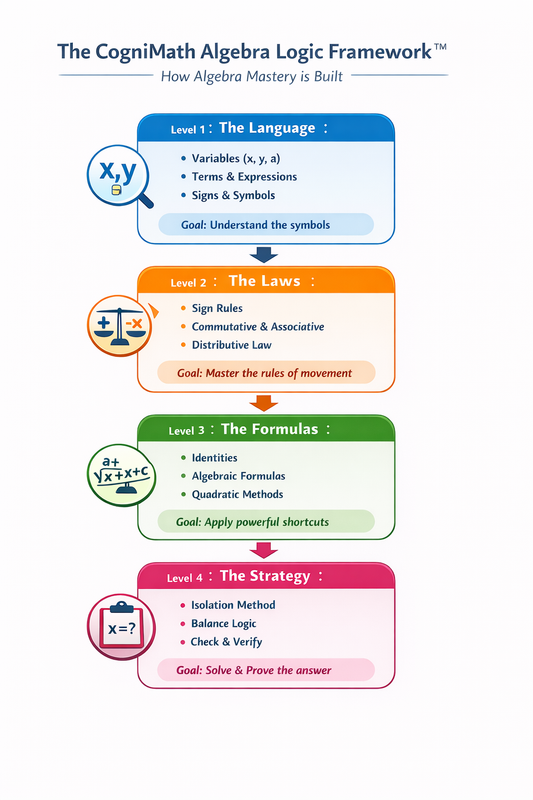
How Every Module Works
Every module follows a structured mastery cycle designed to build deep mathematical thinking. Learners begin by understanding the concept through logic-first explanations, observe worked examples, practise using guided exercises, analyse common reasoning mistakes, complete a checkpoint, and finally demonstrate mastery through the official QSM exam before progressing to the next module.
Learn
Concepts are introduced using reasoning-based teaching methods that explain the meaning behind every algebraic step. Visual examples, logic explanations, and transformation reasoning help learners build long-term conceptual clarity.
Practice
Guided exercises gradually increase in complexity, allowing learners to apply each reasoning method safely before the mastery test. Dedicated mistake-analysis sections highlight the most common logical errors and show how to avoid them.
Prove Mastery
The QSM mastery exam evaluates modelling accuracy, symbolic transformation, and reasoning quality. Result feedback identifies improvement areas and determines readiness for the next stage of the CogniMath™ learning ladder.
Mastery Roadmap (Phases)
The CogniMath™ roadmap is structured as a progressive mastery ladder. Each phase strengthens a specific thinking skill required for the next level, ensuring learners build reasoning depth rather than memorising isolated procedures.
Learners develop equation-balance instincts, understand equality logic, and build the discipline of explaining each transformation step clearly.
Confident solving of one-step and two-step equations with strong verification habits.
Students master symbolic manipulation including simplification, distribution, factoring, and structured multi-step equation solving.
Strong algebra mechanics and the ability to transform complex expressions accurately.
Learners translate real-world situations into algebraic models, solve inequalities, and apply structured reasoning to decision-based problems.
Ability to convert stories into equations, solve them, and validate answers logically.
Functions and graphs are interpreted as real-world stories, enabling learners to analyse patterns, relationships, and decision outcomes.
Advanced algebra reasoning skills allowing interpretation of models, graphs, and symbolic systems like a master-level problem solver.
Modules (7-Core Ladder)
Modules 1–7 are now active. Complete each module’s mastery exam to progress through the ladder.
Module 1 — The Balance Secret
Understand how equations behave like balanced scales. Learn equality logic, missing value identification, and the step-by-step process used to isolate unknown numbers.
Open Module 1Module 2 — The Rule Detective
Develop pattern recognition skills by analysing sequences, detecting numerical rules, and predicting future values using logical reasoning instead of guessing.
Open Module 2Module 3 — Language of Symbols
Learn how letters represent numbers in algebra. Understand variables, substitution techniques, and how symbolic expressions describe mathematical relationships.
Open Module 3Module 4 — The Border Crossing
Master the transformation logic used when numbers move across the equal sign. Understand why operation signs change and how structured steps solve equations efficiently.
Open Module 4Module 5 — Story to Algebra
Translate real-life scenarios into algebraic equations by identifying unknown values, decoding language clues, and building mathematical models that represent real situations.
Open Module 5Module 6 — The Math Machine
Understand input-output systems and functional relationships between variables.
Open Module 6Module 7 — Graph Storytelling
Learn how graphical representations explain trends, relationships, and real-world data patterns.
Open Module 7