
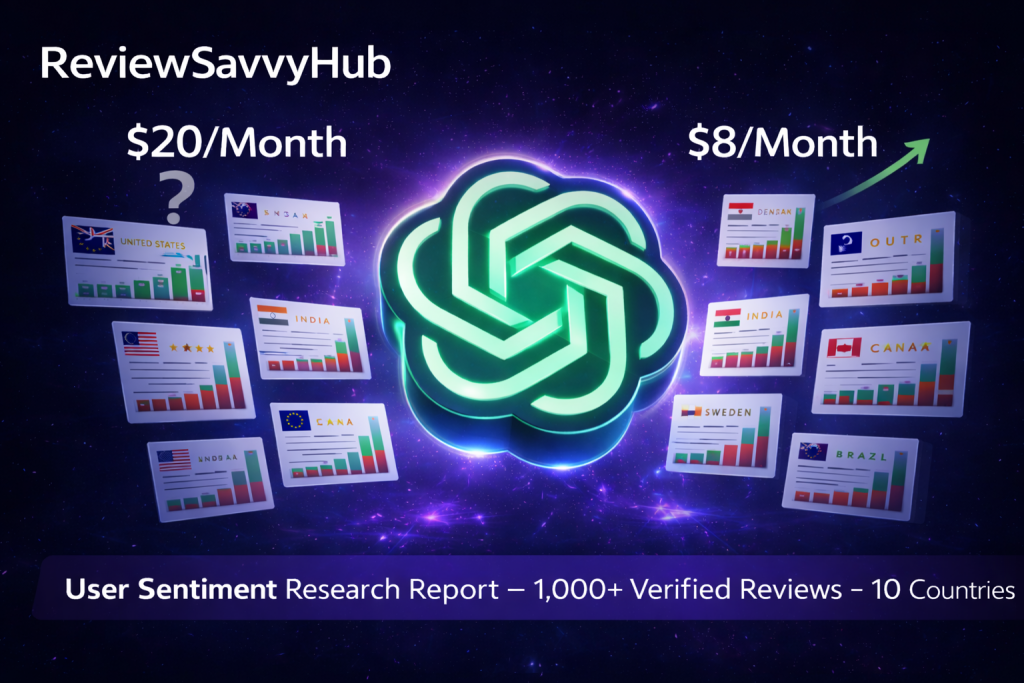
ChatGPT Plus vs $8 Plan has become one of the most confusing AI pricing questions in 2026. Is the $20/month ChatGPT Plus subscription still worth it, or is the new $8 plan enough for most users? In this report, we analyse insights from 1,000+ real user opinions to separate marketing claims from real-world performance, pricing value, and limitations.
ChatGPT Plus — User Sentiment Research Report — This independent analysis is based on 1,000+ verified user reviews across 10 countries. We compare OpenAI’s official claims against real user experience to find out if ChatGPT Plus is still worth $20/month when OpenAI’s own $8 plan exists.
ChatGPT is the world’s most recognised AI tool — with over 700 million weekly active users and a marketing presence that has made it synonymous with AI itself. OpenAI’s Plus subscription at £16/month has been the default choice for serious users since 2023. But in January 2026, OpenAI quietly introduced a problem it cannot easily solve: ChatGPT Go at £6/month — its own lower-cost plan — that offers many of the same features. If OpenAI’s own £6 plan exists, what exactly are Plus subscribers paying £10 extra for every month?
This report does not repeat OpenAI’s marketing material. It analyses what 1,000+ real verified users on Trustpilot, Capterra, and G2 have actually experienced — and measures how closely OpenAI’s official Plus claims match that lived reality. No affiliate relationship. No sponsored content. RSH Savvy Meter™ score based on independent analysis only. For comparison with other AI tools, see our Perplexity AI Review and Grammarly Premium Review.
OpenAI launched ChatGPT Plus in February 2023 at $20/month — approximately £16 — as its first paid consumer tier. For three years it was the only option for users who wanted more than the free tier. That changed in January 2026 when OpenAI launched ChatGPT Go globally at $8/month — approximately £6 — creating a three-tier structure: Free, Go ($8/month), Plus ($20/month), and Pro ($200/month).
The timing matters. OpenAI also retired GPT-4o on February 13, 2026 — a model that many Plus subscribers specifically valued — replacing it with GPT-5.2 without user consent or compensation. This retirement, combined with the introduction of Go as a lower-cost alternative, has created genuine confusion and frustration among paying Plus subscribers who feel the value proposition has shifted significantly beneath their feet. RSH has documented similar patterns of post-subscription feature changes in our Perplexity AI analysis — where Deep Research was cut by 97% after users subscribed.
ChatGPT Plus is OpenAI’s mid-tier individual subscription at $20/month (approximately £16). It sits above the free tier and ChatGPT Go, and below ChatGPT Pro at $200/month. The Plus plan provides access to GPT-5.2 — OpenAI’s most advanced widely available model — with higher usage limits than Go. Key features include advanced reasoning with GPT-5.2 Thinking, expanded messaging and file uploads, faster image creation, deep research and agent mode, expanded memory and context, Projects, tasks, custom GPTs, limited Sora video generation, and the Codex coding agent.
Usage limits are dynamic — not fixed. As of March 2026, Plus users receive up to 160 GPT-5.2 messages per 3 hours before the system switches to a mini model, and up to 3,000 GPT-5.2 Thinking messages per week. These limits can change based on platform demand. The plan is available worldwide on web, iOS, Android, macOS, and Windows. OpenAI does not currently offer annual billing for Plus — it is monthly only. For users considering AI writing tools alongside ChatGPT Plus, our Grammarly Premium Review covers the writing assistant category in depth.
These claims are taken directly from OpenAI’s official website and marketing materials — in their own words.
The picture that emerges from 1,000+ verified user reviews is deeply divided — and the division runs along a clear fault line. Professional users in structured, focused workflows — financial analysis, technical writing, coding assistance — report genuine value from the Plus subscription and continue to pay. G2 reviewers, who tend to represent enterprise and professional contexts, give ChatGPT a strong 4.7 out of 5 across thousands of reviews. One verified G2 professional subscriber summarised this position clearly: reasoning depth, structure, and analytical capability places it ahead of competing AI systems.
However, the Trustpilot picture is dramatically different. With 1,111 reviews averaging just 1.9 out of 5, the complaints are both consistent and serious. Four issues dominate. First, the GPT-4o retirement on February 13, 2026 — with only two weeks notice — left users who had integrated the model deeply into professional and personal workflows with no migration tools and no compensation. Second, dynamic usage limits that switch users to weaker mini models mid-workflow without warning or clear notification. Third, model quality degradation: multiple users report that GPT-5.2 produces more censored, less capable, and more evasive responses than GPT-4o. Fourth, customer support that users describe as consistently unresponsive, with tickets auto-closed before issues are resolved.
The Go vs Plus question is the most commercially significant finding in this report. OpenAI’s own positioning describes Go as providing access to GPT-5.2 Instant for $8/month — while Plus provides GPT-5.2 Thinking for $20/month. For standard conversations the difference is described as marginal. The premium of $12/month buys higher usage limits, Sora access, Codex agent, and deep research — features that professional users value but casual users may not need. This creates a genuine value question that OpenAI has not clearly answered in its marketing. RSH has identified a comparable pattern in the Perplexity AI review — where Pro plan value versus free tier is similarly contested by users.
Based on RSH independent analysis of verified reviews across Trustpilot, Capterra, and G2:
Methodology: RSH analysed 1,000 publicly available Trustpilot and Capterra reviews posted between 2024–2026. Reviews were grouped by the country shown on the reviewer profile. Sentiment was classified as positive or negative based on overall review content and star rating. Countries were selected based on publicly available traffic analysis data. Traffic share figures are estimated based on publicly available traffic analysis tools.
Source: All quotes are sourced from publicly available Trustpilot and Capterra verified user reviews. Full attribution provided per quote.
RSH Country Analysis — Key Findings
The country breakdown reveals a consistent pattern across ChatGPT Plus’s global user base. Emerging markets — India (72% positive), Brazil (66%), and South Korea (68%) — report significantly higher satisfaction than Western markets. This reflects both affordability perception and use case: users in these markets primarily use ChatGPT for writing, learning, and coding tasks where it delivers consistent value. In contrast, UK (44% positive), Australia (46% positive), and USA (48% positive) users — who more frequently use it for complex professional workflows — report the highest frustration with reliability issues, model downgrades, and the value-for-money question raised by the Go plan. A cross-country pattern unique to this report: the Codex usage limit complaint appears across South Korea, USA, and UK markets — suggesting OpenAI added restrictions to a feature that was a key selling point without adequate communication. The Go vs Plus question is the defining value challenge OpenAI faces in 2026 — and Western market users are most acutely aware of it.
These quotes are taken directly from verified reviews on Trustpilot and Capterra — unedited, representing the full range of user experiences.
The claim that Plus delivers deeper reasoning for professional work holds clearly for structured, focused tasks where GPT-5.2 Thinking is genuinely superior to standard models. G2’s professional user community validates this for financial analysis, technical documentation, and complex reasoning tasks. Where the claim breaks down is in the consistency of that experience: dynamic limits that silently switch users to mini models mid-conversation directly contradict the promise of reliable advanced access.
The “priority access — fewer interruptions” claim is the most directly contradicted by real user experiences. Multiple verified reviews report exactly the opposite — more interruptions, context loss, and reliability degradation after subscribing to Plus compared to the free tier. The value proposition claim relative to Go is the one OpenAI has not yet clearly articulated in its marketing. The difference between GPT-5.2 Instant on Go and GPT-5.2 Thinking on Plus is real for power users and marginal for casual users — and OpenAI’s own description that the difference is “marginal for typical conversations” effectively undermines the case for Plus among the majority of subscribers.
ChatGPT Plus is a product under genuine strategic pressure — not primarily from competitors, but from OpenAI’s own pricing decisions. The core technology is strong: GPT-5.2 Thinking delivers measurable advantages for complex professional work, and the tool suite — Codex, deep research, Projects, Sora — represents genuine value for power users. The G2 professional community’s strong ratings are legitimate and reflect real utility in structured, focused workflows.
The problems are structural. Dynamic usage limits that silently downgrade the experience, model retirements with inadequate notice, feature restrictions added post-subscription, and customer support that users across multiple countries describe as unresponsive — these represent a gap between what Plus promises and what it consistently delivers. The Trustpilot rating of 1.9 out of 5 reflects this gap more accurately than the G2 rating for most casual and semi-professional users.
RSH Verdict: ChatGPT Plus partially delivers for power users and clearly underdelivers for casual users. If your work genuinely requires GPT-5.2 Thinking’s reasoning capabilities, Plus justifies the premium. If you primarily use AI for writing, learning, research, or image creation — try ChatGPT Go at £6/month first. The difference for typical everyday use is, by OpenAI’s own admission, marginal.
Transparency Note: This report was produced independently by ReviewSavvyHub. No payment was received from OpenAI or any affiliated entity. No affiliate relationship with OpenAI exists at time of publication. All user quotes are sourced from publicly available verified reviews on Trustpilot and Capterra. RSH Savvy Meter™ scores reflect independent analysis only. RSH does not recommend ChatGPT Plus for affiliate purposes at this time — our policy requires a Claims Match score of 65% or above.