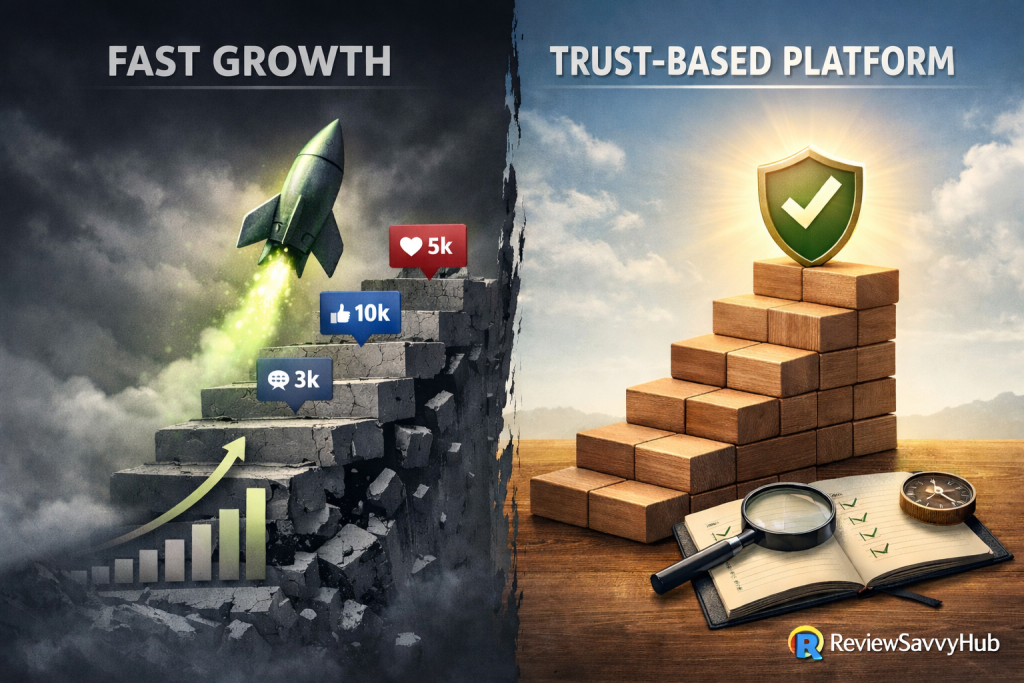
Fast growth tactics rarely fail because they are dishonest.
They fail because they optimise for attention instead of judgment.
Platforms built on trust cannot grow at the same speed as hype-driven systems without losing credibility. The pressure to move fast forces decisions that prioritise visibility over understanding — and that trade-off is costly.
Fast growth looks attractive. Follower counts rise quickly, impressions spike, and screenshots circulate as proof of success. The narrative feels convincing: speed equals progress. For trust-driven platforms, fast growth tactics often feel tempting, but they introduce risks that are invisible in early metrics.
But for platforms built on trust, fast growth tactics often create the very problems they promise to solve. This article explains why growth-first strategies quietly fail trust-based platforms — and why slower, decision-focused models outperform them over time.
Why Fast Growth Tactics Are Not the Same as Progress
Growth metrics measure attention, not understanding. They tell you how many people saw something, not whether anyone became more confident in their decisions.
A platform can grow rapidly while readers remain confused, misled, or disengaged. When growth is prioritised over clarity, content begins to optimise for reach instead of usefulness. The more visible the platform becomes, the less precise its guidance often feels.
Trust-based platforms operate under a different rule. Progress is measured by decision confidence, not reach. If readers leave knowing what not to buy, what not to trust, or what not to rush into, real progress has occurred — even without viral numbers.
How Fast Growth Tactics Force Simplification (And Why That’s Dangerous)
Fast growth tactics rely on simplified messaging. Algorithms reward clarity that fits into short attention windows, which pushes complex ideas into confident statements, universal advice, and clear winners and losers.
But decision-making rarely works this way. Real-world choices involve trade-offs, limitations, and context. When speed becomes the goal, nuance disappears. And when nuance disappears, credibility follows shortly after.
Platforms built on trust cannot afford this simplification. Once readers notice that complexity has been replaced by certainty, trust begins to erode — even if the platform continues to grow.
How Hype Optimises Attention Instead of Outcomes
Hype-driven strategies are designed to be shared, not applied. They create urgency instead of reflection, certainty instead of evaluation, and volume instead of relevance.
The result is engagement without improvement. Readers may feel informed in the moment, but their decisions do not improve in practice. Over time, this gap between confidence and outcome becomes visible — and trust weakens.
This is why fast growth tactics work well for attention-driven creators but consistently fail for platforms built on judgment and clarity.
Why Documentation Beats Promotion on Trust-Based Platforms
Promotion tells people what to believe. Documentation shows how decisions are made.
Trust-based platforms grow when they explain why certain options were rejected, how trade-offs were evaluated, and where limitations exist. They treat uncertainty honestly instead of hiding it behind confidence.
This approach grows slower, but it compounds. Readers who understand the process do not need persuasion. They return because they trust the judgment behind the content, not because they are impressed by its reach.
Why Trust Platforms Win by Losing the Growth Race
Trust-based platforms often appear to lose early. They publish fewer posts, avoid rankings, and refuse shortcuts that could accelerate visibility.
But in doing so, they gain something growth-first models struggle to recover: reader confidence.
When attention fades, trust remains. When algorithms shift, judgment still works. When hype cycles end, clarity retains value.
The Strategic Choice Most Platforms Avoid
Every platform eventually faces a strategic choice.
One path optimises for reach first and attempts to build credibility later. The other optimises for credibility first and accepts slower growth in the beginning.
The first path feels rewarding early. The second path feels frustrating early. But over time, only one builds durable authority.
Final Thought on Fast Growth Tactics and Credibility
Fast growth is not wrong.
It is simply expensive for platforms that trade in judgment.
This is why fast growth tactics must be treated with caution when credibility and decision clarity are the core value being offered.
Trust cannot be rushed without being diluted. And once diluted, it is difficult to restore.
For platforms built on decision clarity, restraint is not weakness — it is strategy.
Transparency Note
This article reflects ReviewSavvyHub’s editorial philosophy. We prioritise clarity, context, and real-world suitability over speed, rankings, or promotional pressure.