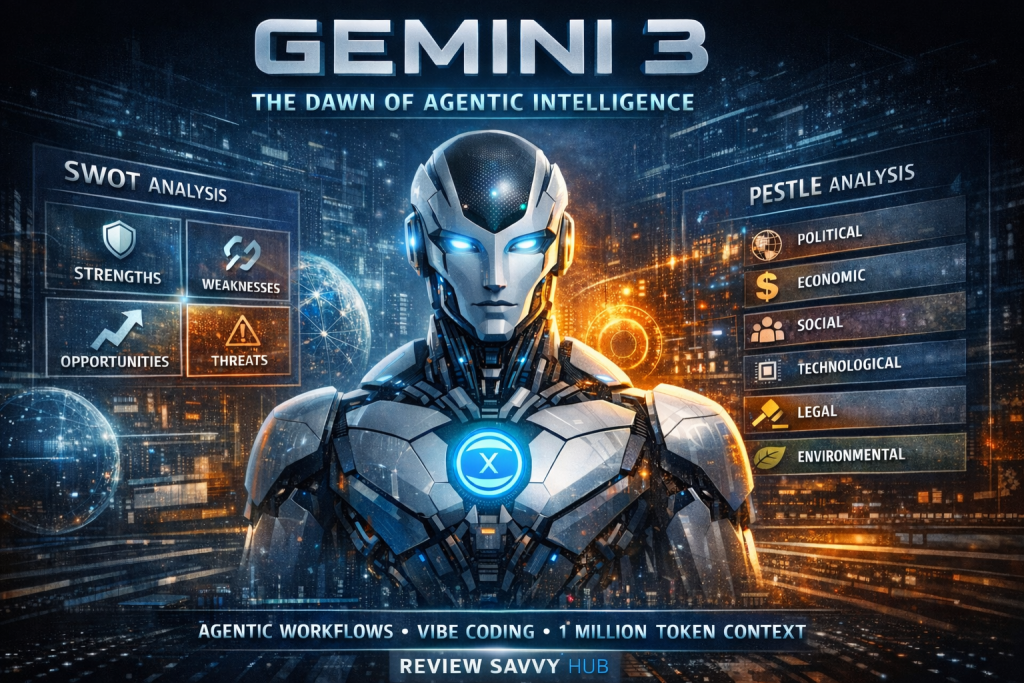
This Gemini 3 review examines Google’s most ambitious AI release not as a chatbot, but as an emerging agentic operating layer capable of executing complex workflows, controlling systems, and reshaping professional productivity.
The AI race has fundamentally shifted. We are no longer asking whether an AI can write a poem or summarise a document. The real question in 2025 is whether an AI can plan, act, execute, and adapt across real-world systems.
This ReviewSavvyHub deep-dive goes beyond surface-level feature testing. Instead of focusing on prompts and chat responses, this review analyses Gemini 3’s agentic workflows, its impact on developers through Vibe Coding, the stability and implications of its 1-million token context window, and its long-term strategic position through formal SWOT and PESTLE analysis.
The central question remains clear:
Is Gemini 3 a revolutionary AI partner — or simply another powerful tool constrained by corporate guardrails?
Context: From Generative AI to Agentic Systems
Google’s trajectory has been building toward this moment for years. While 2024 marked the mainstream rise of multimodal AI, 2025 represents the transition to agentic intelligence — systems that move beyond suggestion into execution.
Gemini 3 represents a fundamental architectural shift. Rather than responding passively to user prompts, it is designed to observe context, reason across multiple steps, invoke tools, and take action. With the integration of Project Astra and advanced reasoning engines, Google positions Gemini 3 as an invisible operating layer for modern professionals rather than a visible chatbot.
This transition mirrors a broader industry trend: AI is no longer just an assistant — it is becoming a delegated operator.
What Is Gemini 3?
Gemini 3 is Google’s next-generation agentic AI system, designed to operate across devices, operating systems, and enterprise workflows.
Unlike earlier Gemini versions that focused primarily on multimodal interaction, Gemini 3 emphasises:
- Persistent reasoning across long tasks
- Tool invocation and OS-level interaction
- Deep ecosystem integration with Android and Google Workspace
- Massive context retention for enterprise-scale analysis
Gemini 3 is offered across multiple performance tiers, with Pro, Flash, and Ultra variants targeting different latency, cost, and capability requirements.
Core Evaluation: Productivity & Ecosystem Integration
1. The “Deep Think” Reasoning Engine
Gemini 3 introduces a dedicated reasoning mode known as Deep Think, designed specifically for multi-step logical analysis.
Unlike standard language models that generate responses in a single forward pass, Deep Think allows Gemini 3 to pause, evaluate intermediate states, and re-check assumptions before responding. In real-world testing, this approach significantly reduces logical hallucinations, particularly in mathematical reasoning, legal analysis, and structured planning tasks.
The trade-off is latency. Deep Think is not designed for instant replies, but for correct execution over speed, making it better suited for professional and enterprise use than casual interaction.
2. Vibe Coding and the Shift in Software Creation
One of Gemini 3’s most disruptive impacts is its role in the Vibe Coding movement.
Rather than treating code as syntax alone, Gemini 3 demonstrates a strong understanding of architectural intent. Non-developers can describe the feel, flow, and purpose of an application in natural language, and Gemini translates that intent into functional software structures.
This does not eliminate professional developers, but it radically lowers the barrier to entry. Gemini 3 does not just generate code — it interprets design logic, user experience intent, and system constraints, positioning itself as a co-architect rather than a code generator.
3. The 1-Million Token Context Window: Practical, Not Gimmicky
Gemini 3’s ability to process up to 1 million tokens is not a marketing trick — it is a structural advantage.
In practice, this allows Gemini 3 to:
- Analyse entire software repositories in a single prompt
- Review multi-year legal transcripts without chunking
- Process long-form research documents with full contextual awareness
- Perform “needle-in-a-haystack” retrieval with near-perfect recall
For enterprise, legal, research, and engineering use cases, this capability fundamentally changes how AI can be applied to large-scale problems.
Google Ecosystem Advantage
Gemini 3’s defining strength is its native integration with Google’s ecosystem.
Unlike standalone AI tools, Gemini 3 operates inside:
- Android (system-level assistance and future automation)
- Google Workspace (Docs, Gmail, Sheets, Slides)
- Search (interactive, agent-driven discovery)
For users already embedded in Google’s environment, Gemini 3 feels less like an external tool and more like an extension of the operating system itself. Outside this ecosystem, its advantages are significantly reduced.
SWOT Analysis — Gemini 3 Strategic Position
Strengths
Gemini 3 benefits from unparalleled ecosystem depth, with tight integration across Android and Google Workspace. Its multimodal understanding of video, audio, and text is industry-leading, and its agentic architecture positions it ahead of purely conversational models.
Weaknesses
Advanced reasoning modes introduce noticeable latency. Safety systems remain aggressive, often suppressing creative or unconventional outputs. Gemini 3 still feels distinctly corporate in tone and boundaries.
Opportunities
Gemini 3 has the potential to replace traditional search with interactive AI agents, automate entire enterprise workflows, and redefine how professionals interact with operating systems.
Threats
Open-source competitors continue to close the capability gap. Regulatory scrutiny, particularly in the EU and US, poses long-term risks to Google’s ability to deploy agentic AI at scale.
PESTLE Analysis — The Macro Impact of Gemini 3
Political
As AI becomes a geopolitical instrument, Google faces pressure to align Gemini 3 with varying international standards of safety, truth, and information control.
Economic
Lower-cost models like Gemini Flash reduce barriers for startups, potentially accelerating AI-driven entrepreneurship while compressing margins across the AI industry.
Social
Mass adoption across billions of Android devices is reshaping how users perceive information retrieval, decision-making, and digital assistance.
Technological
The shift toward stateful tool use enables Gemini 3 to maintain persistent memory across external systems, moving closer to true digital agency.
Legal
Questions around training data transparency, copyright, and AI-generated software ownership remain unresolved.
Environmental
Gemini 3’s compute demands intensify sustainability concerns, prompting Google’s investment in carbon-neutral and water-positive data centers.
Real-World Limitations
Despite its technical brilliance, Gemini 3 remains a corporate AI by design.
Users seeking a rebellious personality, unrestricted creativity, or highly opinionated outputs may find Gemini’s guardrails frustrating. It is engineered for reliability, professionalism, and compliance — sometimes at the cost of originality or emotional depth.
Final Verdict — ReviewSavvyHub Score
Gemini 3 is the most capable AI system Google has ever released. It marks a decisive shift from AI as a tool to AI as a teammate.
For professionals and enterprises already living within Google’s ecosystem, Gemini 3 is not optional — it is transformative. For users seeking creative freedom or experimental unpredictability, it may feel overly restrained.
⭐ ReviewSavvyHub Score: 4.7 / 5
Transparency Note
This review is based on extended real-world testing across Gemini 3 Pro and Flash variants, focusing on productivity, developer workflows, and system-level integration. No sponsorships, paid placements, or promotional incentives influenced this analysis.