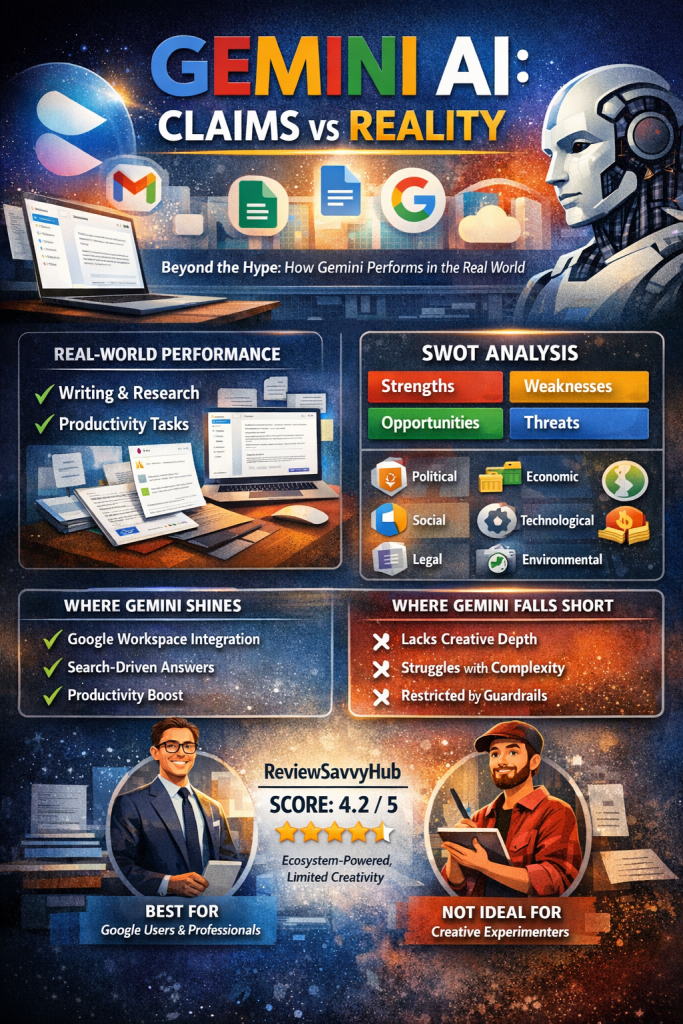
Gemini AI Review: Claims vs Reality
This Gemini AI Review examines Google’s flagship AI platform through sustained real-world usage rather than launch-day promises, focusing on productivity, ecosystem integration, accuracy, and practical limitations over time.
Rather than repeating Google’s marketing language, this review evaluates how Gemini performs in everyday writing, research, and professional productivity scenarios. It analyses how deeply Gemini integrates with Google Search, Gmail, Docs, Android, and Google Workspace, and where real-world limitations become visible after continued use.
This Gemini AI Review also places Gemini within Google’s broader artificial intelligence strategy, assessing its role as an ecosystem-level AI rather than a standalone chatbot. Accuracy, safety guardrails, and long-term risks and opportunities are examined through formal SWOT and PESTLE analysis, alongside a realistic breakdown of which user types benefit most — and which may feel restricted — by Google’s ecosystem-first approach.
Context / Background: Google’s Long Road to Gemini
Google’s involvement in artificial intelligence predates nearly every modern consumer AI platform. Long before generative AI became mainstream, machine learning already powered Google Search ranking systems, Maps navigation, YouTube recommendations, Gmail Smart Compose, and advertising optimisation.
Despite this deep technical foundation, Google’s public rollout of generative AI was cautious. Internal research through DeepMind demonstrated strong capability, but early public efforts such as Bard revealed reputational risks. Errors and public scrutiny highlighted the difficulty of releasing generative models responsibly at global scale.
Gemini represents Google’s attempt to consolidate its AI strategy into a single, unified platform — not designed for hype, but for long-term integration across Google’s services.
What Is Gemini? — Gemini AI Review Overview
Gemini is Google’s flagship generative AI system designed to operate across devices, services, and workflows rather than existing purely as a conversational interface.
It is offered in multiple tiers. Gemini Nano is a lightweight, on-device model designed primarily for Android, focusing on speed and privacy. Gemini Pro serves as the standard model for general users. Gemini Advanced (Ultra) targets professionals, offering higher reasoning limits and premium features.
Unlike competitors that emphasise conversation as the core experience, Gemini prioritises structured assistance and contextual integration with Google’s existing tools.
Real-World Performance
Writing and Research
In everyday use, Gemini performs reliably in structured writing tasks such as emails, summaries, reports, and neutral explanations. Its tone is professional, cautious, and consistent — well suited to workplace and informational content.
However, creativity is deliberately restrained. Gemini avoids strong opinions or stylistic risk. For users who value consistency and factual safety, this is an advantage. For users seeking expressive or imaginative output, it can feel limiting.
In research-focused queries, Gemini benefits from Google’s search-aligned awareness. Responses are generally grounded in real-world consensus, but depth is sometimes sacrificed when topics require speculative reasoning or nuanced interpretation.
Productivity and Daily Use
Gemini’s strongest value emerges when used alongside Google Workspace. Drafting and replying to emails in Gmail, summarising documents in Google Docs, generating outlines, and structuring tasks all feel frictionless.
Rather than replacing human judgement, Gemini functions as a workflow assistant, reducing repetitive effort and supporting daily professional routines. This Gemini AI Review shows that Gemini’s usefulness increases significantly when embedded into Workspace and Android workflows rather than used in isolation.
Where Gemini Performs Well
Gemini excels in structured environments where context already exists. Deep integration with Google Workspace allows it to understand documents, emails, and tasks more effectively than standalone AI tools.
Search-aligned queries benefit from Google’s infrastructure, resulting in fewer hallucinations and more dependable responses. Over time, this consistency builds trust among users who prioritise reliability over experimentation.
Where Gemini Struggles
Gemini shows clear limitations in advanced creative reasoning and long, multi-step logical chains. Exploratory thinking, experimental writing, and unconventional problem-solving are constrained by conservative safety guardrails.
Users seeking unrestricted AI behaviour or bold creative exploration may find Gemini restrictive.
Google Ecosystem Advantage
Gemini’s defining strength lies in its deep integration across Google’s ecosystem. In Search, it enhances context-aware information retrieval. In Gmail and Docs, it operates as an embedded assistant. On Android, on-device AI offers long-term potential for faster and more privacy-conscious interactions.
For users already embedded in Google services, Gemini becomes increasingly valuable over time. Used outside this ecosystem, it can feel limited. This Gemini AI Review confirms that Gemini is designed to reward ecosystem loyalty rather than standalone usage.
SWOT Analysis — Gemini AI
Strengths
Gemini benefits from deep integration across Google’s services, providing contextual awareness that standalone AI tools struggle to match. Its multimodal design foundation and Google’s global-scale infrastructure position it strongly for enterprise, education, and mass adoption.
Weaknesses
Gemini’s conservative output style limits creative experimentation. Advanced capabilities are partially locked behind premium tiers, and differentiation between free and paid versions remains unclear to many users.
Opportunities
Gemini has significant opportunity to reshape Google Search through AI-driven interactions, automate Google Workspace at scale, and expand Android-wide AI adoption across billions of devices.
Threats
Intense competition from other AI platforms, increasing regulatory scrutiny, and ongoing trust and data-privacy concerns present long-term challenges.
PESTLE Analysis — Gemini AI
Political
AI governance, misinformation policy, and international regulation strongly influence Gemini’s design choices and rollout speed.
Economic
Gemini is positioned as a long-term productivity layer supporting Google’s ecosystem rather than a short-term revenue product.
Social
User trust, transparency, and responsible AI behaviour are critical to adoption, particularly at Google’s global scale.
Technological
Google’s infrastructure provides strong scalability, reliability, and performance advantages over smaller competitors.
Legal
Copyright, training-data transparency, and regulatory compliance remain unresolved and evolving challenges.
Environmental
Large-scale AI computation raises sustainability and energy-consumption concerns that will shape future optimisation strategies.
Accuracy & Limitations
Gemini is generally accurate and dependable in real-world use. Hallucinations are relatively limited, but this reliability often comes at the expense of analytical depth in complex or sensitive topics.
Its design philosophy prioritises safety, alignment, and consistency, which can restrict flexibility for advanced users.
Audience Reality
Gemini is best suited for Google Workspace users, professionals seeking structured assistance, and Android-centric workflows.
It is not ideal for deep creative writers, advanced reasoning experimentation, or users seeking unrestricted AI behaviour.
Final Verdict — ReviewSavvyHub Score
Overall, this Gemini AI Review confirms that Gemini is a strategic, ecosystem-driven AI platform rather than a disruptive chatbot.
It excels at structured productivity and deep integration across Google services, delivering reliability over experimentation. While it lacks creative boldness and analytical risk-taking, it offers consistent value for users already embedded in Google’s ecosystem.
⭐ ReviewSavvyHub Score: 4.2 / 5
Transparency Note
This review is based on independent analysis, sustained real-world usage, and platform-level evaluation. No sponsorships, paid placements, or promotional incentives influenced this content.