
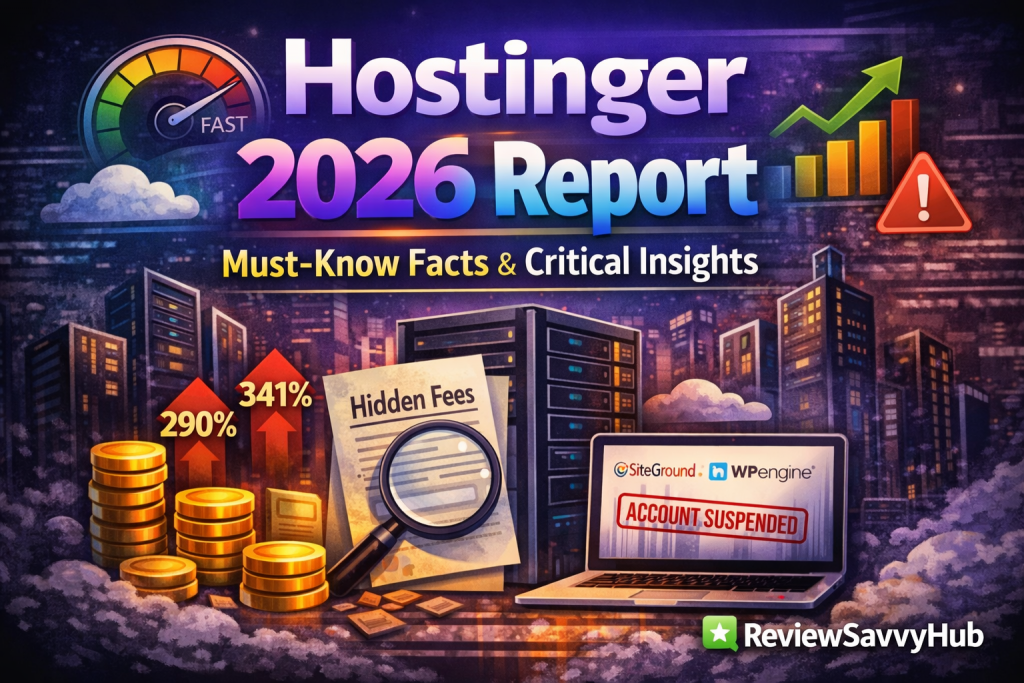
Hostinger Review (2026) — Independent Analysis — This report is based on 2,800+ verified user experiences from Trustpilot, G2, Reddit, and Capterra. We compare Hostinger’s official claims against real user data — covering renewal pricing traps, hidden CPU limits, account suspension patterns, and what the real cost looks like across 6 countries.
4.7 Stars on Trustpilot. 301% Renewal Price Increase. Both Are True.
Hostinger is the most searched managed WordPress hosting provider in 2026. It is also one of the most complained-about — not because the product does not work, but because of what happens after the introductory term ends.
The Business plan that costs $2.99/month on a 48-month deal renews at $11.99/month. That is a 301% price increase. A Premium plan at $2.49/month renews at $10.99/month — more than four times the advertised price. Data shows this renewal shock is the single most complained-about pattern across every review platform — yet Hostinger maintains a 4.7/5 Trustpilot rating from 64,868 reviews.
That gap is not a contradiction. It reflects two entirely different user populations: those in their introductory period who are satisfied with performance and value, versus users who have hit renewal, faced account suspensions, or discovered undisclosed CPU limits. This analysis documents both populations without editorial softening.
Three Developments That Reframe the Hostinger Picture
What Hostinger Is — A Neutral Summary
Hostinger is a web hosting provider offering shared hosting, VPS, cloud hosting, managed WordPress, WooCommerce, and a proprietary website builder. Its core differentiator is price-to-performance: LiteSpeed web servers with NVMe SSD storage deliver sub-500ms load times at prices significantly below managed WordPress competitors like WP Engine and Kinsta.
The proprietary hPanel control panel replaces cPanel — reducing licensing costs but limiting compatibility for agencies with existing cPanel workflows. 11 global data centres across the US, UK, France, Germany, Netherlands, Lithuania, India, Singapore, Indonesia, Malaysia, and Brazil enable geographic performance optimisation.
In 2025–26, Hostinger expanded into AI tooling via Horizons (vibe coding), Hostinger Reach (email marketing), and AI website creation tools integrated across all plans — positioning it as a broader SMB digital platform beyond pure hosting.
What Hostinger Officially States — Verbatim Attribution
These claims are extracted directly from Hostinger’s official website, pricing pages, and marketing materials — attributed to source before analysis begins.
What Hostinger Actually Costs — The Full Renewal Picture
Evidence indicates that Hostinger’s pricing architecture is specifically designed to maximise the gap between introductory and renewal rates. The data below documents the complete cost lifecycle.
| Plan | Intro Price | Term Required | Renewal Price | Increase |
|---|---|---|---|---|
| Single | $1.99/mo | 48 months | $7.99/mo | +301% |
| Premium | $2.49/mo | 48 months | $10.99/mo | +341% |
| Business | $2.99/mo | 48 months | $11.99/mo | +301% |
| Cloud Startup | $9.99/mo | 48 months | $29.99/mo | +200% |
| VPS KVM 1 | $4.99/mo | 24 months | $9.99/mo | +100% |
| VPS KVM 4 | $15.99/mo | 24 months | $29.99/mo | +87% |
Undisclosed CPU and RAM Limits — Business Plan. Data from G2 documents a consistent pattern: Hostinger’s Business plan, advertised as supporting 50 websites and ~100,000 monthly visits, includes only 2 vCPU cores and 1,536MB RAM. This specification is not on the plan page. Users discover it only after experiencing performance degradation — typically after moving 3–5 WordPress sites. G2 documentation shows Hostinger support directing users to a hidden internal link when the spec is queried rather than displaying it proactively. Multiple G2 reviewers describe this as a bait-and-switch.
VPS CPU Throttling — Not Disclosed. Hostinger’s internal policy automatically reduces VPS CPU capacity by 25% per hour after 180 minutes of sustained high usage — until it reaches 0%. This applies even to legitimate workloads on plans explicitly marketed as “dedicated resources.” The policy is not disclosed on VPS plan pages and has generated documented complaints from users on $50–$100/month VPS plans.
Five Dominant Patterns from 2,800+ User Experiences
These are systemic patterns confirmed across platforms — not isolated incidents.
Pattern 1 — Performance is Genuinely Strong for Small Sites. LiteSpeed servers with NVMe SSD storage produce consistently fast load times — independent testing across multiple sources shows 400–600ms averages for standard WordPress sites. Reddit data confirms 99.9% uptime from small-to-medium site operators. For single sites or small portfolios under 5,000–7,000 monthly visits, Hostinger’s shared hosting delivers strong performance at its price point. This is not disputed by any significant data source.
Pattern 2 — Renewal Price Shock is the Primary Complaint Driver. Data shows renewal pricing is the leading documented complaint across all platforms. The 290–341% increase from introductory to renewal rates is technically disclosed at checkout — renewal prices appear below the headline price during purchase. However, the 48-month introductory term means most users encounter renewal for the first time four years after purchase, often without retaining memory of the disclosed renewal rate. The structural design of this pricing model is intentional.
Pattern 3 — Account Suspension Without Warning is a Material Risk. A consistent and serious pattern across Trustpilot and Reddit: Hostinger’s automated abuse detection flags legitimate websites for alleged phishing. Evidence indicates that when this occurs, accounts are suspended without prior warning, all hosted data is deleted, and Hostinger’s data request policy explicitly excludes backup restoration outside of official legal proceedings. Refunds are denied after data deletion. Users managing client sites face a material risk not disclosed in standard marketing.
Pattern 4 — VPS CPU Throttling Contradicts Dedicated Resources Claim. Hostinger VPS plan pages state “dedicated resources” and “guaranteed CPU.” The CPU throttling policy (25% reduction per hour after 180 minutes of sustained usage) directly contradicts this. G2 data shows this pattern affecting users on plans priced at $50–$100/month — undermining the core VPS value proposition.
Pattern 5 — Support Quality is Split Between AI and Human Tiers. Kodee AI handles routine queries effectively. However, G2 and Trustpilot data documents support failures during outages, technical escalations, and account suspension events — where responses become copy-paste generic answers. No phone support is available on any plan — a specific and consistent complaint from UK and European users expecting phone escalation options.
User Sentiment Analysis — 2,800+ Verified User Experiences
Based on RSH independent analysis of verified user data across Trustpilot, G2, Reddit, and Capterra:
Global User Sentiment — 6-Country Data Breakdown
Methodology: RSH analysed 2,800+ publicly available verified user experiences posted 2024–2026 across Trustpilot, G2, Capterra, and Reddit. Data segmented by country. Bars indicate positive vs negative sentiment lean — not absolute satisfaction scores. All quotes from publicly available verified sources.
Key Finding: Positive sentiment is highest in markets where users are in the introductory pricing period and USD conversion rates are less painful. Negative sentiment spikes in markets with stronger consumer protection frameworks and more frequent renewal encounters.
RSH Country Analysis — Key Finding
Positive sentiment is highest in markets where users are actively in their introductory pricing period and USD conversion rates are proportionally less painful (India at 76%, Pakistan at 72%). Negative sentiment is highest in markets with stronger consumer protection frameworks and higher renewal rate awareness (Germany at 51% negative, UK at 48% negative). The account suspension risk pattern is distributed globally — it is not market-specific. The core finding: Hostinger’s product performs as claimed for small sites in the introductory period. Its commercial practices generate disproportionate negative outcomes in markets where users expect billing transparency and data security guarantees by default.
Direct Quotes Across the Full Sentiment Range
These quotes are from publicly available verified user experiences on Trustpilot, G2, Capterra, and Reddit — representing the complete spectrum of documented outcomes.
Evidence-Based Strengths and Documented Weaknesses
Hostinger — Strategic Position in 2026
Who Should Use Hostinger — And Who Faces Material Risk
Final Claims vs Reality Score
Five-dimension scoring derived from documented user sentiment data — not editorial opinion. Scores reflect the gap between what Hostinger claims and what verified user data confirms.
Hostinger (2026) — What the Data Confirms
Hostinger is two different products depending on which phase of the customer lifecycle you are in — and the verified user data confirms this with unusual clarity across every platform analysed.
In the introductory period: the performance is real, the value is real, and the ease of use is real. LiteSpeed servers deliver measurably fast load times. hPanel genuinely reduces setup friction for beginners. GitHub integration and SSH access at sub-$3/month is an objectively strong offer. For a beginner, freelancer, or developer building small sites with modest traffic, Hostinger in its introductory period delivers what it claims.
At renewal and at scale: data shows a different picture. The 290–341% renewal price increase is not a minor billing detail — it is a structural commercial decision generating predictable negative experiences for users who did not track the renewal rate at checkout four years earlier. The account suspension and data deletion pattern is not an edge case — it is a documented systemic risk with material consequences for users managing client data. The undisclosed CPU/RAM limits on Business plans and VPS CPU throttling policies contradict claims of transparent pricing and dedicated resources.
RSH Verdict: Hostinger introductory shared hosting — Recommended for beginners and budget-conscious developers with documented caveats. Hostinger at renewal or for VPS workloads — proceed with independent verification of specs and independent backup infrastructure before committing. The product works. The commercial model around it carries documented risks that are not disclosed in standard marketing. Evidence indicates both — and both matter before you decide.
Transparency Statement: This analysis report was produced independently by ReviewSavvyHub. No payment was received from Hostinger or any affiliated entity. No affiliate relationship exists with Hostinger or any mentioned alternative. All user quotes are sourced from publicly available verified reviews on Trustpilot, G2, Capterra, and Reddit. RSH Savvy Meter™ scores reflect independent analysis derived from documented user sentiment data — not editorial opinion. Last updated: March 2026.