Editorial Hook – The Promise vs The Reality
AI agents vs human workflows have become one of the most debated productivity shifts in modern business automation.
AI agents are increasingly promoted as the ultimate productivity solution for modern businesses.
Software companies promise fully autonomous systems that can manage tasks end-to-end, replace slow human workflows, and deliver faster outcomes at lower cost. From finance departments to customer service teams, organisations are being told that intelligent agents can now plan, decide, and execute without human involvement.
The claim sounds revolutionary.
However, when these systems are implemented in real operational environments, the results often reveal a different picture.
While AI agent workflows undoubtedly improve speed and automation, they also quietly remove the human judgement layers that traditionally protected organisations from risk, error, and ethical failure.
This analysis explores the real-world performance of AI agents compared to human workflows — separating productivity claims from operational reality.
Context & Background
Workflow automation has existed for decades. Businesses have long used software tools to speed up repetitive tasks such as data entry, scheduling, and reporting.
What has changed recently is the emergence of agentic AI systems. These are no longer simple automation scripts. Modern AI agents can interpret information, set sub-goals, connect multiple tools, and complete complex processes without direct human instruction.
In many organisations, AI agents are now being deployed to:
Handle customer queries autonomously
Approve transactions
Optimise marketing campaigns
Screen job candidates
Manage logistics decisions
This marks a shift from assistance to autonomy.
Instead of supporting human workers, AI agents are increasingly positioned as replacements for entire workflow chains.
What Are AI Agent Workflows and Human Workflows?
AI Agent Workflows
AI agent workflows operate through continuous data monitoring and algorithmic optimisation. An AI agent is given a goal — such as reducing costs, increasing response speed, or improving conversion rates — and it then determines how to achieve that outcome.
It can pull information from databases, trigger software tools, make probabilistic decisions, and execute actions instantly.
The system does not pause for reflection or question unusual scenarios unless explicitly programmed to do so.
It focuses on efficiency.
Human Workflows
Human-driven workflows are structured around decision checkpoints.
Employees review information, assess context, verify unusual cases, escalate concerns, and apply experience-based judgement. Even when processes appear slow or bureaucratic, they naturally include safeguards.
Humans notice anomalies.
They question shortcuts.
They sense risk beyond numbers.
This is not inefficiency — it is a built-in protection mechanism.
Real-World Performance: What Actually Happens in Practice
In controlled environments and predictable tasks, AI agents perform exceptionally well.
They process large volumes of data without fatigue. They execute repetitive tasks flawlessly. They monitor systems continuously and respond faster than any human team could.
In these areas, productivity improvements are real and measurable.
However, problems begin when AI agents take over workflows that involve complexity, judgement, or human impact.
Across industries, organisations have reported that while automated agents speed up operations, they also introduce new forms of risk.
Financial systems have experienced rapid automated failures triggered by AI-driven decisions.
Recruitment platforms have amplified hidden bias within training data.
Customer service automation often resolves issues technically but leaves customers frustrated and dissatisfied.
The common pattern is consistent:
The workflow becomes faster, but thinner.
Decisions are made earlier, with less scrutiny, and without contextual understanding.
Comparison: AI Agent Workflows vs Human Workflows
AI agents excel in environments where outcomes are predictable and measurable. They bring speed, consistency, and scale that humans cannot match.
Human workflows, in contrast, excel where reality is messy. They adapt to unusual situations, recognise ethical concerns, and apply contextual reasoning.
Where AI agents optimise toward performance targets, humans balance outcomes against long-term consequences.
This difference is critical.
AI systems are built to optimise.
Humans are built to judge.
When organisations replace judgement-heavy workflows with autonomous optimisation, they gain efficiency but lose resilience.
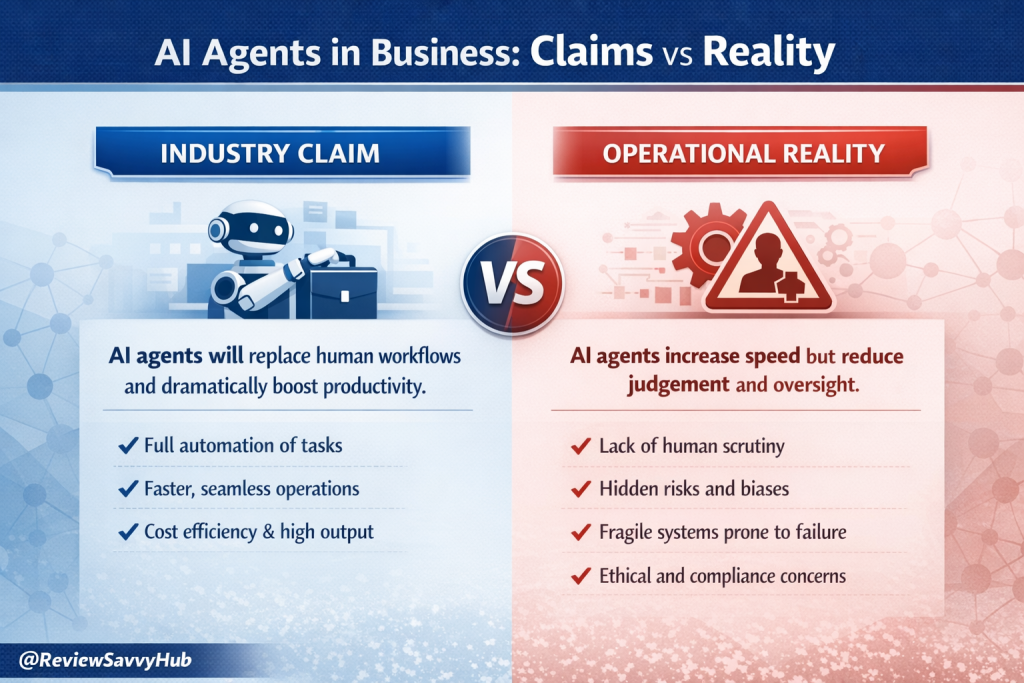
Claims vs Reality Snapshot
Industry Claim
AI agents can fully replace human workflows, delivering massive productivity gains without compromising quality or safety.
Operational Reality
AI agents dramatically improve speed and automation but often remove the judgement layers that prevent errors, ethical failures, and systemic risk. Over time, this can lead to fragile systems that perform well until they suddenly fail.
SWOT Analysis – AI Agent Workflows
AI agent workflows offer undeniable strengths. They enable rapid execution, operate continuously, reduce operational costs, and scale effortlessly across large systems.
However, they also suffer from fundamental weaknesses. They lack contextual understanding, struggle with edge cases, and cannot apply ethical reasoning. Their tendency to optimise narrowly toward metrics can create unintended consequences.
There are strong opportunities in using AI agents to support human teams. Automating repetitive tasks and data-heavy processes can free employees to focus on higher-level judgement and strategy.
At the same time, significant threats exist. Over-automation can lead to systemic failures, regulatory intervention, reputational damage, and loss of trust among customers and employees.
PESTLE Analysis
Politically, governments are increasingly focused on regulating AI-driven decision systems, particularly where automation impacts citizens directly.
Economically, while AI agents reduce short-term labour costs, they can expose organisations to expensive failures and compliance risks in the long run.
Socially, widespread automation raises concerns about workforce displacement and the erosion of human oversight.
Technologically, AI agents are advancing rapidly in execution capabilities but remain limited in true understanding and contextual reasoning.
Legally, organisations face growing liability for automated decisions that result in harm or discrimination.
Environmentally, continuous AI processing increases energy consumption and infrastructure demand.
Accuracy & Limitations
This analysis reflects current real-world implementations of AI agents across business environments.
Results vary by industry and by the level of human oversight maintained. AI technology continues to evolve, and future systems may improve contextual handling.
However, present-day patterns consistently show that fully autonomous workflows increase efficiency while accumulating hidden risk.
Audience Reality: Who Should and Shouldn’t Rely on AI Agents
AI agents are highly effective for predictable, high-volume, repetitive processes where outcomes are clearly defined.
They are far less suitable for environments involving complex decision-making, ethical judgement, regulatory sensitivity, or high human impact.
In such areas, full autonomy often creates more problems than it solves.
Final ReviewSavvyHub Verdict
AI agents represent a powerful evolution in workflow automation.
But the claim that they can fully replace human workflows is misleading.
While autonomous systems deliver impressive productivity gains, they often undermine the judgement structures that protect organisations from failure.
The most resilient model is not full automation.
It is hybrid workflow systems where AI handles execution and scale while humans retain oversight, context, and accountability.
Efficiency without judgement creates fragile operations.
Automation without human review creates hidden risk.
The future of productivity lies in augmentation — not replacement.
Transparency Note
This ReviewSavvyHub analysis is based on observed organisational automation outcomes, documented AI system failures, and real-world patterns in workflow optimisation. No marketing claims or sponsored material influenced this evaluation.