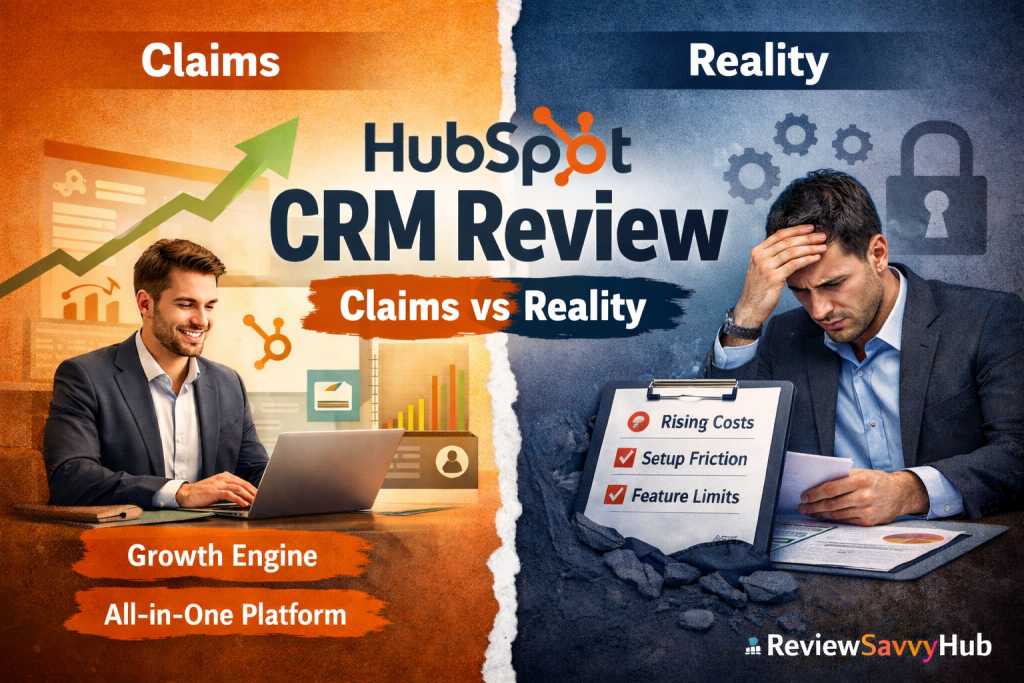
HubSpot CRM Review is a practical, judgement-based evaluation of how the platform performs beyond marketing claims, focusing on real-world usability, pricing realities, and long-term scalability.
HubSpot CRM is often presented as an all-in-one growth engine for modern businesses — but real-world usage tells a more layered story. In this review, we examine what HubSpot CRM actually delivers once onboarding ends and daily operations begin. We break down its pricing structure, real usability for small and growing teams, automation limits, AI features, and long-term scalability. We also compare HubSpot with Salesforce and Zoho to clarify where it truly fits — and where it doesn’t.
This is not a feature list or a sales pitch. It’s a practical evaluation designed to help businesses decide whether HubSpot CRM is a sustainable tool or a costly commitment over time.
Context: How HubSpot Became the Industry Standard
HubSpot did not start as a CRM company. It began as an inbound marketing platform built around content, SEO, and lead nurturing. The CRM came later — as a way to centralise customer data and keep users inside a single ecosystem.
Over time, HubSpot expanded aggressively across multiple hubs:
- Marketing Hub
- Sales Hub
- Service Hub
- Operations Hub
What emerged was not just a CRM, but a business operating layer that connects marketing, sales, and support under one interface.
This history explains HubSpot’s greatest strength — and its most overlooked risk.
What HubSpot CRM Really Is (Beyond the Marketing Page)
HubSpot CRM is not a single product. It is a gateway into a modular SaaS ecosystem.
At its core:
- The Free CRM provides contact management, deal tracking, and basic reporting.
- Paid tiers unlock automation, advanced workflows, custom reporting, and AI-assisted features.
- Pricing scales by seats, not just features.
This structure makes HubSpot extremely approachable at the beginning — and increasingly expensive as teams grow.
HubSpot is not built for experimentation.
It is built for commitment.
Real-World Performance: Daily Usage Reality
Where HubSpot Performs Exceptionally Well
- Clean, intuitive interface
- Minimal training required for new users
- Unified view of contacts, deals, and activity
- Reliable uptime and platform stability
- Strong reporting for standard workflows
For small teams, HubSpot feels almost frictionless.
Where Friction Appears
- Automation depth is locked behind higher tiers
- Advanced reporting requires paid hubs
- Customisation is limited compared to enterprise CRMs
- Manual CRM hygiene still matters more than marketing implies
HubSpot reduces admin work — but it does not eliminate it.
Poor data discipline still produces poor outcomes.
HubSpot Breeze AI: Beyond the Hype
HubSpot’s AI features, branded under Breeze AI, focus on productivity rather than autonomy.
They assist with:
- Lead prioritisation
- Email and content suggestions
- Workflow efficiency
What Breeze AI Does Not Do
- Replace strategic judgement
- Eliminate human oversight
- Automatically fix poor CRM processes
This is not a flaw. It is an important reality check.
HubSpot’s AI is supportive, not decisive. Any business expecting autonomous decision-making will be disappointed — and rightly so.
Comparison: HubSpot vs Salesforce vs Zoho
HubSpot CRM
- Best for: SMBs and mid-market teams
- Strength: Ease of use, unified ecosystem
- Risk: Scaling costs and feature gating
Salesforce
- Best for: Large enterprises
- Strength: Deep customisation and control
- Risk: Complexity and heavy admin overhead
Zoho CRM
- Best for: Budget-conscious teams
- Strength: Broad feature access at lower cost
- Risk: UI consistency and learning curve
HubSpot sits in the middle — simpler than Salesforce, more polished than Zoho, but priced accordingly.
SWOT Analysis
Strengths
- Industry-standard user experience
- Strong ecosystem and integrations
- Unified customer data across teams
Weaknesses
- Scaling costs rise quickly
- Feature access tied to pricing tiers
- Platform dependency over time
Opportunities
- AI refinement within workflows
- Expansion into mid-market operations
- Deeper automation without added complexity
Threats
- Price-sensitive customer churn
- Increasing competition from modular CRMs
- SaaS fatigue among growing teams
PESTLE Analysis
- Political / Legal: Strong data protection compliance, but evolving AI regulation may increase responsibility requirements
- Economic: Subscription-based pricing exposes teams to rising operational costs
- Social: Businesses increasingly demand transparency over automation
- Technological: Rapid AI adoption raises expectation gaps
- Environmental: Cloud-based infrastructure aligns with digital efficiency trends
Accuracy & Limitations
HubSpot delivers exactly what it promises at entry level.
Where expectations need adjustment is scalability.
It is accurate to call HubSpot powerful.
It is misleading to call it inexpensive at scale.
HubSpot does not try to be everything — but it does encourage long-term platform dependence.
Audience Reality: Who Should — and Shouldn’t — Use HubSpot
Best Fit
- Startups planning structured growth
- SMBs needing alignment between marketing and sales
- Teams prioritising usability over deep customisation
Risky Fit
- Cost-sensitive businesses
- Companies with highly complex workflows
- Teams unwilling to commit to a single ecosystem
Should Avoid
- Organisations needing extreme CRM flexibility
- Businesses seeking low-cost scaling at volume
Final Verdict (RSH Score)
HubSpot CRM is not overhyped — but it is often misunderstood.
It excels as a growth platform for teams that value clarity, structure, and integration. Its weakness lies not in capability, but in cost trajectory and long-term dependency.
RSH Score: 4.2 / 5
Strong, reliable, and battle-tested — provided you enter with clear expectations.
Transparency Note
This review is independently researched and written by ReviewSavvyHub. No rankings were sold, and no paid placements influenced the analysis. Affiliate relationships, where present, do not affect conclusions or verdicts.