Opinion & Insight | ReviewSavvyHub
The Invisible Problem Organisations Keep Missing
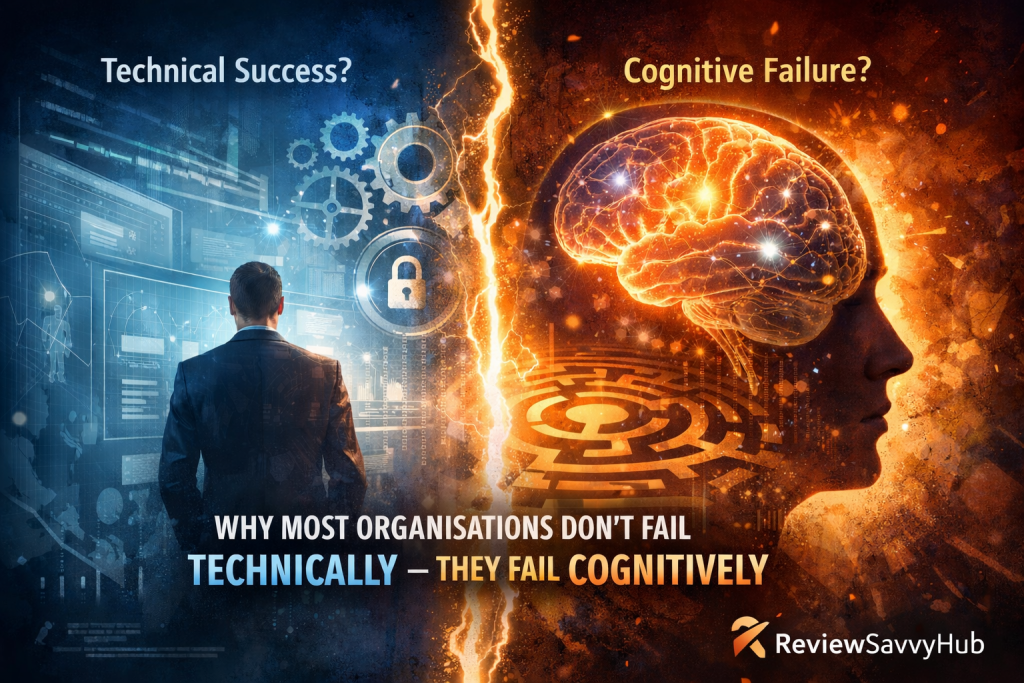
Most organisations fail cognitively long before they fail technically.
When a data breach happens, when a fraudulent payment slips through, or when a critical operational mistake costs millions, the post-mortem usually sounds familiar.
“The process was correct.”
“The controls were in place.”
“Training had been completed.”
And yet, the failure still happened.
This is the uncomfortable reality most organisations avoid confronting:
systems rarely fail on paper — they fail in human decision moments.
This is why organisations fail cognitively even when their technical systems appear robust on paper. The gap is not infrastructure. The gap is judgement under pressure.
The Illusion of “Good Training”
Most corporate training programmes are built on a flawed assumption:
that knowing the rules automatically leads to correct action.
In practice, this creates what can only be described as compliance theatre.
Employees recognise interfaces but not system logic.
Policies are memorised but not internalised.
Checklists exist but collapse under urgency.
Authority pressure overrides judgement.
When stress, fear, or time pressure enters the picture, cognition shifts. Decision-making becomes reactive rather than rational. This is not a technical problem — it is a cognitive one.
Traditional learning models rarely account for this shift. They assume calm environments, linear thinking, and perfect recall. Real-world decision environments are none of these.
From Knowledge to Reflex: The Missing Layer
The Neuro-Learning Framework™ does not treat learning as information delivery. It treats learning as behavioural conditioning under realistic pressure.
The framework is built on a simple but uncomfortable premise:
Most organisational losses are caused not by a lack of knowledge,
but by incorrect decisions made under stress, authority, or urgency.
What organisations actually need is not more awareness. They need decision reflexes that survive pressure, ambiguity, and hierarchy.
The 7-Layer Architecture of Decision Integrity
Rather than teaching people what to do, the framework trains how thinking unfolds when things go wrong.
Each layer addresses a specific cognitive failure point that repeatedly appears across industries.
1. Purpose Over Protocol
When people understand why a system exists, blind compliance and shortcut-driven behaviour decrease dramatically.
2. Mental Model Mapping
Learners visualise dependencies and downstream impact instead of operating in isolated tasks. This prevents local decisions from causing systemic damage.
3. Stress-Tested Exploration
Real-world loopholes are simulated in controlled environments, allowing behavioural gaps to surface safely rather than catastrophically.
4. The Cognitive Ladder
Decision-making is trained progressively, embedding the STOP–VERIFY–ESCALATE reflex as instinct rather than instruction.
5. Impact-Loop Feedback
Every decision generates visible financial and operational consequences, making cause and effect tangible instead of theoretical.
6. Error-Driven Resilience
Mistakes are analysed, not hidden. Competence is built through correction, reflection, and iteration.
7. The Project Spiral
Scenarios repeat at increasing complexity, ensuring judgement scales from routine operations to organisational crisis.
Together, these layers convert static knowledge into durable decision integrity.
Why This Matters Now
Modern organisations operate in environments where:
- Fraud is increasingly social and psychological
- Automation hides decision points instead of eliminating them
- AI accelerates processes while amplifying human error
- Compliance requirements increase as attention spans decrease
In this environment, training that stops at awareness is no longer neutral — it is risky. When organisations fail cognitively, technical systems often become amplifiers of error rather than safeguards.
How ReviewSavvyHub Uses This Lens
At ReviewSavvyHub, this framework is not presented as theory. It is used as an analytical lens.
When we evaluate tools, platforms, or organisational workflows, we ask:
- Does the system reduce human-centric risk — or merely document it?
- Does it strengthen judgement under pressure?
- Does it support independent reasoning beyond onboarding flows?
- Does it close loopholes — or assume perfect human behaviour?
This approach allows our reviews to move beyond feature lists and marketing claims, and into decision-grade analysis.
Final ReviewSavvyHub Judgement
The most dangerous assumption in modern organisations is simple:
“If people know what to do, they will do it.”
Reality proves otherwise — repeatedly.
Organisations do not collapse because systems are broken. They collapse because decisions fail under pressure. The Neuro-Learning Framework™ does not promise perfection, but it does something far more valuable: it makes failure predictable, visible, and trainable before it becomes real.
In a world where one wrong click can cost millions, addressing how organisations fail cognitively is no longer optional.
Transparency Note
This article reflects ReviewSavvyHub’s independent analytical opinion.
The Neuro-Learning Framework™ is a proprietary cognitive and decision-analysis model developed to evaluate organisational learning, behaviour, and risk. It does not claim medical, neurological, or therapeutic authority.