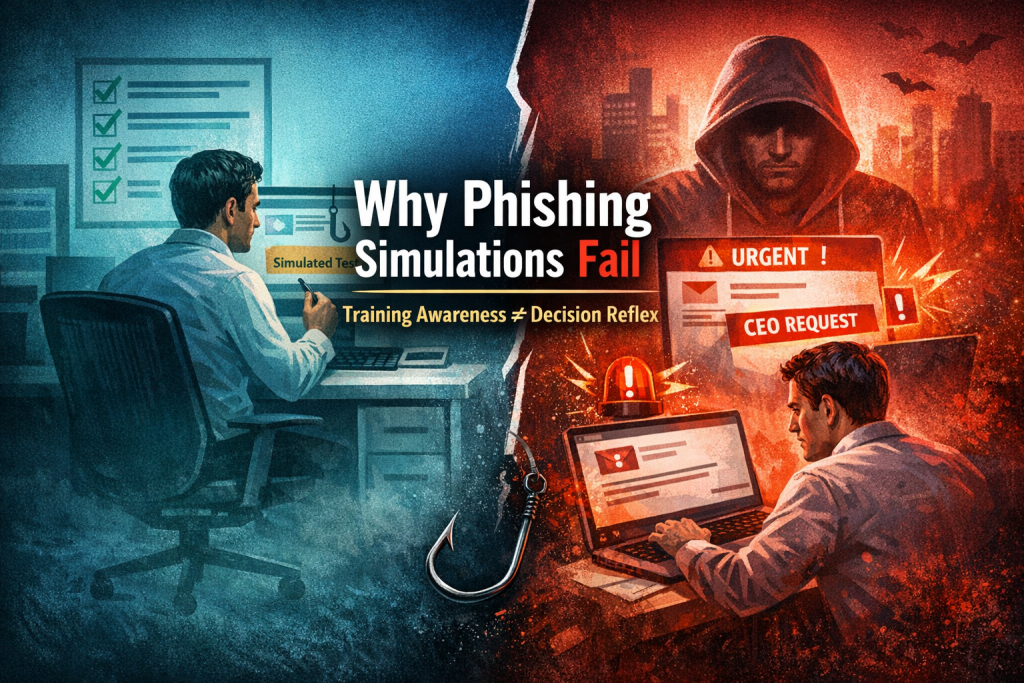
When Training Builds Awareness — But Breaks Judgment
Why phishing simulations fail is not a technical mystery, but a human one rooted in how judgment breaks under pressure.
Editorial Hook — Claims vs Reality
Most organisations believe phishing is a solved problem because everything they can measure tells them so.
Employees complete mandatory training modules. Simulation scores improve year after year. Reporting rates go up. Click-through rates go down. Audit dashboards turn reassuring shades of green. From a distance, the system looks disciplined, mature, and under control.
What these signals really measure, however, is not readiness. They measure compliance inside a protected environment.
When a real phishing attack succeeds, it often feels shocking precisely because it contradicts the data. The people involved were trained. They had passed simulations. They knew the rules. In hindsight, they can usually explain exactly what they should have done differently.
This contradiction creates a convenient narrative: someone made a mistake.
But this explanation collapses under scrutiny. The failure is rarely caused by ignorance, carelessness, or lack of instruction. It happens because the organisation trained people to perform well in a safe, predictable context, and then expected that performance to hold under pressure, hierarchy, urgency, and fatigue.
Phishing simulations are excellent at proving that people can recognise threats when they have time, space, and permission to think. Real phishing attacks are designed to remove all three.
The result is a system that builds confidence in the wrong capability. Awareness improves. Judgment does not.
That gap — between what training prepares people for and what reality demands of them — is where phishing continues to succeed.
Phishing Is a Decision Attack, Not a Knowledge Test
Most organisations still treat phishing as if it were a problem of insufficient awareness. The underlying assumption is simple: if people know what phishing looks like, they will avoid it. Training programs, simulations, and assessments are all built around this belief.
But this assumption quietly misunderstands how human decision-making actually works.
Phishing does not succeed because people fail to recognise danger. It succeeds because the attack is engineered to ensure that recognition never becomes the dominant process in the first place. Real phishing emails are not puzzles waiting to be solved. They are prompts designed to trigger action before analysis has time to surface.
In calm conditions, the human brain is capable of careful evaluation. It can compare sender addresses, examine links, question tone, and cross-check intent. That mode of thinking is slow, deliberate, and effortful. It requires the brain to feel that time is available and that hesitation is permitted.
Real phishing attacks remove both assumptions.
They arrive at moments when the recipient is already cognitively loaded — in the middle of work, between meetings, under deadline pressure, or toward the end of a long day. They are framed in language that implies urgency or authority, subtly signalling that delay itself could be harmful. In those conditions, the brain does not ask, “Is this suspicious?” It asks a far more primitive question: “What response keeps things moving?”
This is where the misconception about training becomes dangerous.
When an employee later explains, “I knew better,” they are usually telling the truth. Knowledge was present. Awareness existed. The failure occurred because knowledge is not what governs behaviour when speed, hierarchy, and consequence converge. In those moments, behaviour is governed by habit, reflex, and organisational conditioning.
Phishing is therefore not an intelligence test. It is not even a vigilance test. It is a decision attack — one that targets the automatic pathways people rely on to function efficiently inside organisations.
Until this distinction is understood, training will continue to optimise the wrong skill. Organisations will keep improving recognition, while attackers continue exploiting the conditions under which recognition never gets a chance to operate.
What Phishing Simulations Actually Train
Phishing simulations are often described as “realistic,” but realism is not defined by appearance alone. It is defined by psychological conditions, and this is where simulations quietly diverge from reality.
In a simulated environment, the employee operates inside an unspoken safety net. Even when the simulation is unannounced, there is a background awareness that this is training. Nothing truly breaks if the wrong decision is made. No real operational damage follows. No senior authority is genuinely disappointed. No irreversible consequence unfolds.
This matters more than organisations realise.
Human decision-making is highly sensitive to perceived consequence. When consequences feel distant or symbolic, the brain allocates time and attention differently. It allows itself to slow down. It permits doubt. It tolerates hesitation. In that state, analytical reasoning can surface and function properly.
Phishing simulations unintentionally encourage this mode.
Employees take a few extra seconds. They look more closely. They apply rules they have memorised. They perform well — not because they have developed resilient judgment, but because the environment allows judgment to exist.
Real phishing attacks remove that permission.
In live conditions, hesitation does not feel neutral. It feels risky. An unanswered email from a senior figure can be interpreted as incompetence or obstruction. A delayed response can feel like negligence. The organisational culture — often unconsciously — reinforces the idea that speed is professionalism.
Simulations do not reproduce this pressure. They cannot replicate the internal tension of deciding whether to slow down when everything in the environment signals that slowing down is the wrong move.
As a result, simulations train people to succeed in a context that never truly exists during real attacks. They measure performance under safety, then assume that performance will hold under stress. This assumption is rarely tested — until an actual breach makes it visible.
The irony is that simulations are not failing because they are poorly designed. They are failing because they are asked to train something they were never built to train: judgment under social and organisational pressure.
Recognition vs Reflex — The Hidden Gap
The most important failure point in phishing is not technical, and it is not educational. It is behavioural.
There is a fundamental difference between recognising a threat and interrupting yourself before responding to it. Most organisations assume these two are naturally linked. They are not.
Recognition is a conscious process. It relies on attention, comparison, and time. Reflex is an automatic one. It relies on habit, hierarchy, and emotional cues. When both are available, recognition can guide action. When they conflict, reflex almost always wins.
This is where phishing simulations quietly mislead organisations.
In training environments, recognition dominates because reflex is never fully activated. The email may look suspicious, but nothing about it feels socially dangerous. There is no genuine authority relationship at stake. No implicit cost to slowing down. No risk attached to hesitation.
In real attacks, those conditions reverse.
An email that appears to come from a senior leader does not arrive as a neutral object to be analysed. It arrives embedded in a relationship. Years of workplace conditioning activate instantly. Respond quickly. Do not create friction. Do not be the person who slows things down.
This response is not deliberate. It is automatic.
At that moment, the brain is no longer asking whether the email is legitimate. It is asking how to behave appropriately within the organisation. The decision shifts from accuracy to alignment. From caution to cooperation.
Recognition still exists in the background, but it is overruled. Not because the person forgot the rules, but because reflex has been trained far more consistently than hesitation ever has.
Organisations unknowingly reinforce this imbalance every day. Speed is praised. Responsiveness is rewarded. Questioning is tolerated only when it does not delay outcomes. Over time, employees learn that acting quickly is safer than acting carefully — even in ambiguous situations.
Phishing exploits this perfectly.
It does not defeat knowledge. It bypasses it.
Until organisations recognise that reflex is the default mode under pressure, training will continue to strengthen the wrong pathway. Employees will know what phishing looks like, and still respond in ways that contradict that knowledge.
The Moment Where Judgment Collapses
Judgment rarely collapses in dramatic ways. There is no panic, no visible confusion, no sense that something dangerous is happening. In most phishing incidents, the moment of failure feels ordinary.
That ordinariness is precisely the problem.
The email arrives at a plausible time. The tone is calm, professional, and brief. The request fits naturally within the recipient’s role. Nothing about it demands suspicion. Everything about it demands cooperation.
The employee does not sit back and analyse. They do not consciously weigh risks. They respond in the same way they respond to dozens of legitimate requests every week — by acting efficiently.
In that instant, the decision is not framed as security versus risk. It is framed as responsiveness versus obstruction. The internal question is not, “Could this be phishing?” but “Is there any reason not to do this now?”
This is where training expectations break down.
From the organisation’s perspective, the employee has failed to apply what they were taught. From the employee’s perspective, they have behaved exactly as they have been conditioned to behave: promptly, helpfully, and without unnecessary friction.
The collapse of judgment does not occur because the individual lacks knowledge. It occurs because hesitation has never been legitimised as the correct response in moments that feel operationally normal.
Phishing attacks thrive in this narrow space — where everything feels routine, yet the consequences of acting are severe. By the time recognition catches up, the action has already been taken.
When organisations review these incidents afterward, the analysis often focuses on what the employee missed. What is rarely examined is why the system made not acting feel more dangerous than acting.
Until that question is addressed, the same pattern will repeat — regardless of how many simulations employees pass.
The False Confidence of Compliance Metrics
Once phishing simulations are embedded into organisational routines, they begin to generate numbers. Those numbers quickly become reassuring.
Click rates decline. Reporting rates improve. Completion percentages rise. Over time, these figures are assembled into dashboards that suggest progress, maturity, and control. For leadership teams, this data offers something deeply comforting: proof that the risk is being managed.
The problem is not that these metrics are inaccurate.
The problem is that they measure the wrong thing.
Compliance metrics capture how people behave when they know they are inside a controlled system. They show that employees can follow rules when the environment allows time, safety, and cognitive space. What they do not capture is how those same employees behave when hesitation feels costly.
This distinction is subtle, but critical.
When leadership sees improving metrics, a quiet shift occurs. Responsibility is assumed to have moved downstream. Training has been delivered. Awareness has been raised. If a breach now happens, it must be because someone failed to apply what they knew.
This is how organisations begin to personalise a systemic failure.
In reality, the training system has done exactly what it was designed to do. It has produced measurable compliance. What it has not produced is reliable judgment under pressure — because judgment under pressure is not something dashboards are built to detect.
The danger of these metrics is not that they exist, but that they create confidence without evidence. They signal readiness without testing it. They allow organisations to mistake procedural success for behavioural resilience.
When an incident occurs, post-incident reviews often circle back to the same question: why didn’t the employee follow the process? What is rarely asked is whether the process was designed for the moment in which the decision was actually made.
Compliance data does not fail organisations. Misinterpretation of that data does.
As long as green dashboards are treated as proof of preparedness, organisations will continue to underestimate the conditions under which judgment collapses — and overestimate the protection their training provides.
The Structural Failure Behind Repeated Incidents
When phishing incidents repeat inside the same organisation, the instinctive response is almost always corrective rather than reflective. Training is refreshed. Simulations are increased. Awareness reminders are circulated again. The underlying belief is that repetition indicates resistance — that people simply need to be told more clearly, or more often.
But repetition rarely signals ignorance.
It signals misalignment between training and reality.
If employees repeatedly fail despite passing training, the failure cannot logically sit with the individual. The system has already confirmed that they understand the rules. What it has not confirmed is whether the rules are usable in the conditions where decisions are actually made.
This is where structural failure becomes visible.
Most organisations design security controls as if decisions happen in isolation. In reality, decisions happen inside workflows, hierarchies, deadlines, and social expectations. An employee does not choose between “secure” and “insecure” behaviour in a vacuum. They choose between competing risks: delaying work, questioning authority, appearing unresponsive, or complying quickly and moving on.
Training programs rarely acknowledge this trade-off. They assume that caution is always the safest option. Organisational culture often communicates the opposite.
Over time, employees learn what the system truly rewards. They notice that speed is praised more consistently than scrutiny. They see that smooth execution is valued more than friction. They observe that questioning a request, especially from senior roles, is tolerated only when it does not slow outcomes.
This is not written anywhere, but it is learned everywhere.
Phishing exploits precisely this gap between stated policy and lived reality. It succeeds not because policies are unclear, but because real-world incentives quietly contradict them. When employees act “incorrectly,” they are often acting in alignment with the behaviours the organisation has consistently reinforced.
As long as training addresses rules without addressing incentives, incidents will repeat. The organisation will keep diagnosing the symptom while leaving the structure untouched.
Repeated phishing breaches are not a mystery. They are a predictable outcome of systems that teach people what to notice, but never teach them when it is safe to hesitate.
What Good Actually Looks Like
Organisations that become genuinely resilient to phishing do not try to make people smarter. They try to make hesitation normal.
This is a subtle but fundamental shift. Instead of asking employees to recognise more threats, these organisations focus on changing what feels acceptable in moments of uncertainty. The goal is not perfect detection. The goal is reliable interruption.
In resilient environments, slowing down is not framed as inefficiency. It is framed as professionalism. Employees are not expected to instantly respond to authority-driven requests when context is unclear. They are expected to pause, verify, and escalate without fear of being seen as obstructive.
This does not happen through policy statements alone. It happens through repeated behavioural design.
People are trained in small, realistic moments where hesitation feels uncomfortable but correct. They experience scenarios where the socially “right” action is to delay rather than comply. Over time, this rewires instinct. The reflex shifts from respond quickly to pause briefly.
Crucially, leadership behaviour mirrors this design. When senior figures visibly welcome verification, uncertainty stops feeling like incompetence. When managers reward interruption rather than speed, employees learn that caution carries social protection.
Resilient organisations also reduce ambiguity around verification. They make it clear what to do instead of acting. Not in the form of complex procedures, but in simple, repeatable patterns that fit naturally into work rhythms. When uncertainty arises, there is a known next step that does not rely on courage in the moment.
What emerges is not paranoia or friction for its own sake. It is a calibrated form of deliberate delay — just enough to allow judgment to surface before reflex takes over.
This is what “good” looks like in practice. Not perfect vigilance, but designed hesitation.
Final ReviewSavvyHub Judgement
Phishing simulations do not fail because organisations misunderstand technology. They fail because organisations misunderstand themselves.
They assume that knowledge governs behaviour, when in reality behaviour is governed by pressure, hierarchy, and habit. They measure performance in safe conditions and expect it to hold when safety disappears. They reward speed in daily work and then express surprise when speed overrides caution in moments that matter.
This contradiction is not accidental. It is structural.
By focusing on awareness, organisations avoid confronting the harder question: what behaviours are actually being reinforced when no one is watching? What feels safer in real time — hesitation or compliance? Delay or responsiveness? Questioning authority or aligning with it?
Phishing succeeds because it aligns perfectly with the answers most organisations have already given.
Until training is designed for the moment when hesitation feels socially risky, it will continue to prepare people for a reality that never exists during real attacks. Employees will keep passing simulations. Dashboards will keep turning green. And breaches will keep happening — quietly, predictably, and explainably.
The uncomfortable truth is this:
Phishing does not exploit ignorance.
It exploits the behaviours organisations reward.
Until organisations learn to reward hesitation, they will continue to train failure.
Transparency Note
This analysis is independent, tool-agnostic, and unsponsored. It is based on established principles from cognitive psychology, organisational behaviour, and real-world security incident analysis. The article represents an original synthesis and judgement-based interpretation rather than a summary of a single source.